


Good Morning Digital Neighbors! Happy Tuesday Friends & Refugees, Phamily & ADD Irregulars, Early Birds & Later Dayers, Dawn Patrol and Day Walkers, Conversants, Lurkers and all you other Visitors to Locals!
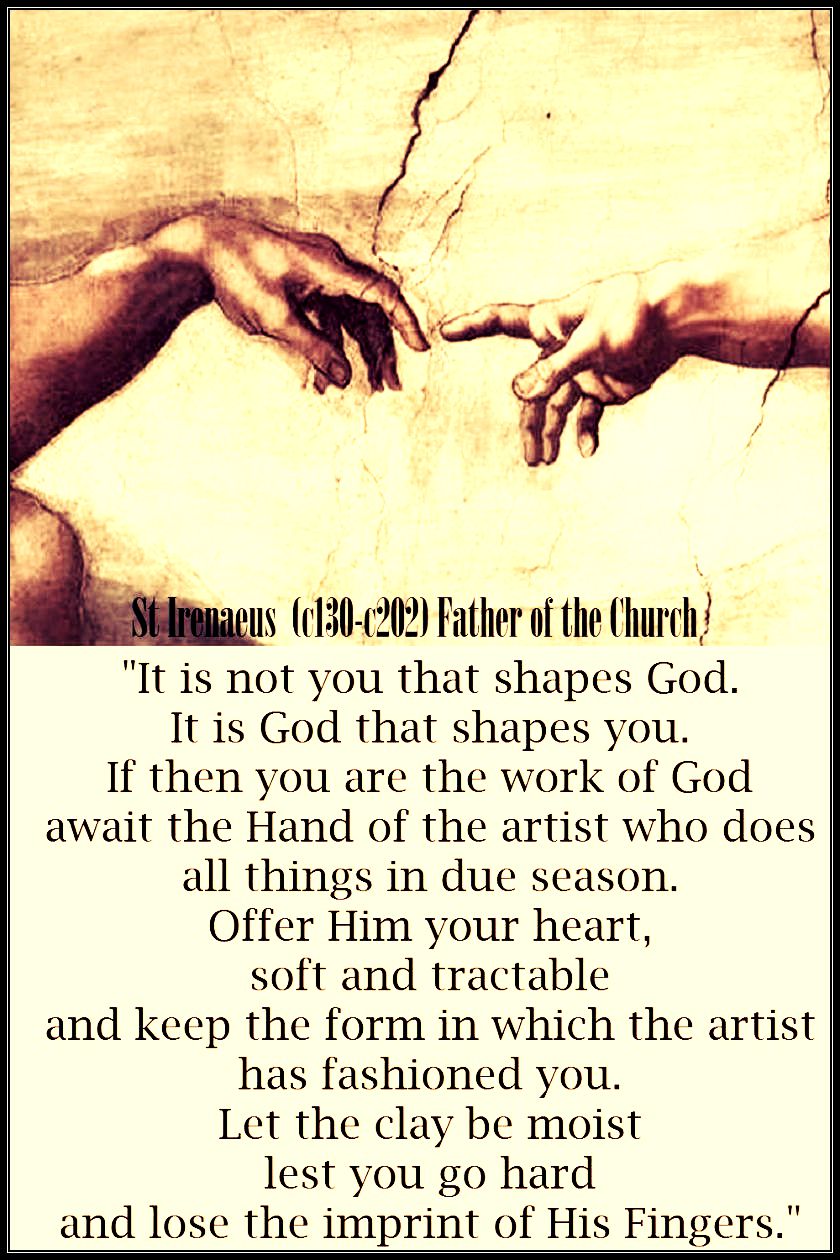
In Cath-O-land we are celebrating the feast of St. Irenaeus. A brief bio and some quotes from this saint who is linked to the age of the Apostles.
St. Irenaeus was an early Church Father in the 2nd century. He was mentored by St. Polycarp, himself a disciple of St. John the Evangelist. St. Irenaeus became Bishop of Lyons and fulfilled his calling as a prolific writer. Most notably, he defended the faith against the intellectual imperialism of the Gnostics; refuting their claims by defining truth as available to all. He said truth is public, unifying, and pneumatic (permeating). Additionally, St. Irenaeus helped identify the canon of scripture and the creed.
“The glory of God is man fully alive.”
Probably the most frequent quote from the saint. To be fully alive is not to be consumed by ones self-fulfillment and misguided judgment but rather to seek enlightenment by knowing, loving and following Christ. The Good News is proportionally good in comparison to what you believe is the wretched condition of your current state. For Disciples of the Master, to be fully alive is to come to know His will, His mercy and His hope and embrace that in your life as your ultimate good. No mindful disciple proclaims his or her own perfection, we all struggle against the reality of sin.
To some degree we are all victims of our own hypocrisy, but if you are mindful of your short comings, honest about your faults, working on overcoming your inclinations, you are not a hypocrite. The hypocrite is blind or oblivious to all those things. You are a sinner. I am not certain of the degree of anyone's sinfulness, but I am certain of mine. My plank before your splinter, but if you care about someone, you ought to speak of the splinter with some courage, compassion and humility. Loving your neighbor is messy business. No pedestals for the living, and no trampling upon the fallen or lowly.
“The business of the Christian is nothing else but to be ever preparing for death.”
This is supposed to be one of the hallmark characteristics of a Christians. It created an age of martyrs for the first few centuries in the church. If you are unafraid of death, you are a free person. The suffering part may be a bit problematic, I imagine a long enough period of suffering has the potential to break any of us. If we avoid thinking of death, the reality of suffering, we live lives of constant apprehension. It will be a life of constant "No" to anything that may cause potential harm or injury, illness or risk.
Echoes of 2020 still aggravate me to this day with its idiotic mantra of "if it saves only one life." It sounds so noble and it is utterly unrealistic. All of life is risk, small or great, if you want to get on with the business of living. There no escaping the eventual date with death, so one ought to ask how best to spend time and make the best decisions with the time they possess. What we live for and what we are willing to die for serve as excellent boundaries for whatever we think our life means. Discern well so that your last words aren't "Hey, watch this. . . " "Hold my beer" "Oh oh " or "Oh crap" One can set an earlier appointment with death through poor decisions.
"In proportion to God's need for nothing is our need for communion with God."
It is why I am what I am. Seeking communion with God and helping others to do the same. God knows, and He does, I don't do it perfectly. I am another sinner on the path of conversion, but loving Him and neighbor (digital and physical) is what I try to make the business of my living. I have my rough edges, my sinful allowances that need to rooted out by the Master Gardener and I am thankful for His patience and grace.
Well, enough rambling if you have read all of that. Happy Tuesday to all of you visiting Rubin Report, Phetasy or Padre's and stumbling across this post and giving it some of your time.


Today marks the three hundred and thirtieth birthday of the Frenchman François-Marie Arouet, better known by his nom de plume, Voltaire (1694-1778).
Born into a bourgeois family during the reign of Louis XIV, the “Sun King” (r. 1643-1715), Voltaire suffered tragedy at a young age when his mother died. Never close with his father or brother, Voltaire exhibited a rebellious attitude toward authority from his youth. His brilliant mind was fostered in the care of the Society of Jesus, who introduced him to the joys of literature and theater. Despite his later criticisms against the Church, Voltaire, throughout his life, fondly recalled his dedicated Jesuit teachers.
Although he spent time as a civil servant in the French embassy to the Hague, Voltaire’s main love was writing—an endeavor where he excelled in various genres, including poetry, which led to his appointment as the royal court poet for King Louis XV. Widely recognized as one of the greatest French writers, and even hyperbolically referred to by ...
Padre - Tom Miller invites you to a Coffee Talk, Speakeasies, Schmoozes, Tea Times, Afterhours and other gatherings.
https://teams.live.com/meet/93792382189049?p=DiBHsYfuECPgDrG7vO
2026 Coffee Talk with the ADD Irregulars
Thursday, January 1, 2026
6:00 AM - 8:00 AM (CST)
Occurs every day starting 1/1 until 12/31/2027
Coffee Talk - Daily beginning at 6:00 AM Central Time Zone - USA
White Pilled Wednesday - A break from the heaviness of news and current events to focus upon things more personal & positive for the first hour of Coffee Talk.
Afternoon Chats - Most Tuesday, Friday & Sundays 2:00 PM Central
Other chats as posted in the community.








XIII
The Proud Minister
One day there came into the Garden a man in torn clothes badly bruised and cut, who said to the Lover, “In the name of the Beloved I demand your help.”
So the Lover and the Disciple let him in and dressed his wounds and prepared the best of the vegetables from the Garden for him to eat. When his wounds had been dressed and he had eaten and rested the Lover asked him how he had fallen into this plight, to which the man replied, “I was Minister of the Beloved in a city near this place, where I preached His gospel and expounded His doctrine to the people. I pointed out to them how their sins had made them wholly hateful to the Beloved and how therefore they were utterly beyond the range of His love and He would condemn them to eternal torments, whereon some fell into despair and wept bitterly but many were angry. One day the magistrates called me before them and begged me to leave the city and preach elsewhere for they said I had made many people so angry and desperate that they feared there might be a riot and they might not be able to protect me but that I might suffer some injury. I, however, very zealous for the Beloved and believing that the magistrates only feared that their own sins might be proclaimed, preached the more vehemently, denounced the magistrates and made it abundantly clear that the whole wicked city was foredoomed to eternal punishment by the just provision of the Beloved. Whereon a mob, stirred up no doubt by the corrupt and venal magistrates, fell upon me with sticks and stones, nearly killing me and driving me out of the city in the state in which I came to you.”
“My friend,” said the Lover, “this was not a good deed of yours, for besides denying the unfathomable compassion of the Beloved, you have by your obstinacy caused these people to commit a grievous sin, and this cannot be pleasing to the Beloved, that through you who profess to be His minister the people should become worse. Surely you remember that He Himself said, ‘If they persecute you in one city flee to another.’”
Therefore the man was very angry, and cursing the Lover, said, “I see that I have had a very false report of you and I do not believe that you are a servant of the Beloved at all. When I came to you so injured for the Beloved’s sake you set before me only herbs and fruits although the garden is full of birds which you could have killed to make me a worthy meal. I shall proclaim everywhere that you are no true servant of the Beloved but a mere falterer who dares not suffer in the cause of the Beloved. Be sure that you are foreordained to eternal torments who suffer nothing here.”
For the man was so blinded by his own pride that he could not perceive the scars on the hands and feet and the brows of the Lover nor how the cloth beneath the armpits of his tunic was dyed with a red dye. So he went out of the Garden cursing and shouting.
But the Lover looked sad and said, “A man like this does much harm to the cause of the Beloved, for by thus speaking falsely about the Beloved he may bring men to fear Him but none to love Him, and by love alone can any man approach the Beloved.”