

February 23, 2025
Trump Must Speak
By J.R. Dunn
In the span of a few weeks, Donald Trump has carried out one of the most sweeping political revolutions in modern history. Using DOGE as his battering ram, he has crippled the Democrats, exposed machinery of corruption that would have beggared the imaginations of Boss Tweed and Ted Pendergast, and effectively ended a political era going back a century or more. He—along with Elon Musk and his merry band of nerds—has uncovered a system of public theft and money laundering that, in the end, may account for trillions of dollars over the last eighty years. And it has just started. Wait until the DoJ and Congress enter the field.
It will likely be years before we grasp the full magnitude of the DOGE revolution. The Democrats already have—and they’re running like rabbits. The D.C. housing market has collapsed, with more than 14,000 houses listed over the past two weeks. You won’t find many Republicans selling. Google Analytics reveals that the most common search terms in D.C. over the past week have included “defense attorneys,” “statute of limitations,” and “overseas accounts.”
The impact of this has been muted, largely by the media, which instead has spent its time bleating about “constitutional crisis” and “President Musk.” So, the public at large has not quite grasped the import of what has occurred, appearing to look at it as a Beltway uproar that sensible people should pay no attention to.
Which is why Donald Trump needs to make a speech.
The role of speeches as political events can scarcely be overemphasized. When we think of critical events in the historical record, we often think first of the speeches associated with them. In his Funeral Oration in 431, Pericles, as presented in Thuycides, outlined for all time the role of the republic in human affairs. At Gettysburg, Abraham Lincoln, in a few short words, reiterated the promise of American democracy. In 1940, in the midst of near-catastrophe, Winston Churchill rallied Great Britain to stand alone against one of the most vicious tyrannies in the historical record. We could go on: Martin Luther King’s “I have a dream,” Ronald Reagan’s “Tear down this wall.” A speech can act as a kind of historical punctuation, telling us when something has ended and when something has begun…or is beginning.
It’s true that Donald Trump is not a speechifyin’ man. He’s a first-rate communicator—none better on the current scene. But memorable speeches or phrasemaking don’t leap to mind where Trump is concerned. Trump gets his point across with simple words, a rather ornate form of repetition (the literati who like to sneer seem to have missed the fact that Trump’s repeated phrases are usually variations, making the point clearer by adding a kind of three-dimensional effect), and a syntax all his own. All of which is fine. He gets his point across, which is all that counts. But there comes a time for something more formal, and that time has now arrived.
Such a speech would be simple in outline. It would consist of Donald Trump explaining what we’re fighting against, how the Deep State and its bureaucratic appendages began, how it grew and flourished, becoming the universal tumor that exists today, and how such a thing cannot be tolerated in a healthy republic. (A simple reason would be the fact that concentrating the incredible levels of funding required by this monolith will always attract grifters, hustlers, and cheats, as it plainly has. We could call this “the Hunter effect.”)
He could then go into the damage that it has caused on all levels. This wouldn’t take much—everybody has their own story.
He could then explain what he did about it and why.
He would go on to tell what we can expect, and how the American people can benefit. (We’re not going to hear this anyplace else. The legacy media has been almost dead silent about Trump’s tax refund plan, which guarantees that all Americans will share in the windfall created by Elon’s efforts. From what I can see, the only thing wrong with this is that it could be inflationary—it might be best to split it into two payments—one for 2025 and one a year later.)
Trump could then move on to the opposition, the people who want to reassert bureaucratic control and take back all those billions. (Or is it trillions by now?) He should name names and lay down challenges. It would be interesting to see how Chuck and Adam and Nancy respond to this.
Finally, he could tell the American people what the results will be—what we can look forward to with all the savings, all the extra cash, and that tremendous political weight removed from our shoulders. There are a lot of things that have been put on the back burner over the past half century due to stolen funds, bureaucratic interference, and simple political indolence and inertia. The possibilities that could be opening up are tantalizing. Elon Musk’s vision of a humanized Mars is only one example.
A renewed world is beginning to attain clarity, a world I could not have imagined as recently as a month ago. With a few well-chosen words, Trump could help usher it into existence. He has knocked down the wall. Now, let him tell the world about it.


Today marks the three hundred and thirtieth birthday of the Frenchman François-Marie Arouet, better known by his nom de plume, Voltaire (1694-1778).
Born into a bourgeois family during the reign of Louis XIV, the “Sun King” (r. 1643-1715), Voltaire suffered tragedy at a young age when his mother died. Never close with his father or brother, Voltaire exhibited a rebellious attitude toward authority from his youth. His brilliant mind was fostered in the care of the Society of Jesus, who introduced him to the joys of literature and theater. Despite his later criticisms against the Church, Voltaire, throughout his life, fondly recalled his dedicated Jesuit teachers.
Although he spent time as a civil servant in the French embassy to the Hague, Voltaire’s main love was writing—an endeavor where he excelled in various genres, including poetry, which led to his appointment as the royal court poet for King Louis XV. Widely recognized as one of the greatest French writers, and even hyperbolically referred to by ...
Padre - Tom Miller invites you to a Coffee Talk, Speakeasies, Schmoozes, Tea Times, Afterhours and other gatherings.
https://teams.live.com/meet/93792382189049?p=DiBHsYfuECPgDrG7vO
2026 Coffee Talk with the ADD Irregulars
Thursday, January 1, 2026
6:00 AM - 8:00 AM (CST)
Occurs every day starting 1/1 until 12/31/2027
Coffee Talk - Daily beginning at 6:00 AM Central Time Zone - USA
Afternoon Chats - Most Tuesday, Friday & Sundays 2:00 PM Central
Always invited, never expected.
Other chats as posted in the community.

Good morning, Digital Neighbors! Blessed Sabbath and a most beautiful Saturday to all you good readers across Locals and Substack. We have had a wonderful week of weather, and it looks like another one is on the way. We could use some rain. We went from a very verdant pattern all the way through the beginning of August, and then it dried up and heated up for about two months. The summer heat only broke after the second week of October. Many older trees seem unaffected, but many smaller ones did not fare as well. It looks to be a muted Autumn in the foothills of the Ozarks, but there are splashes of color here and there that still make for a wonderful season.
Off to some more quotes from M. Scott Peck's anthology. The last section of the chapter on happiness is a collection of quotes on happiness itself. While the world is too messed up to ignore how bad and fragile things are, I keep returning to my immediate day-to-day world, and I find an abundance of peace and happiness resting upon reasonable...


XIII
The Proud Minister
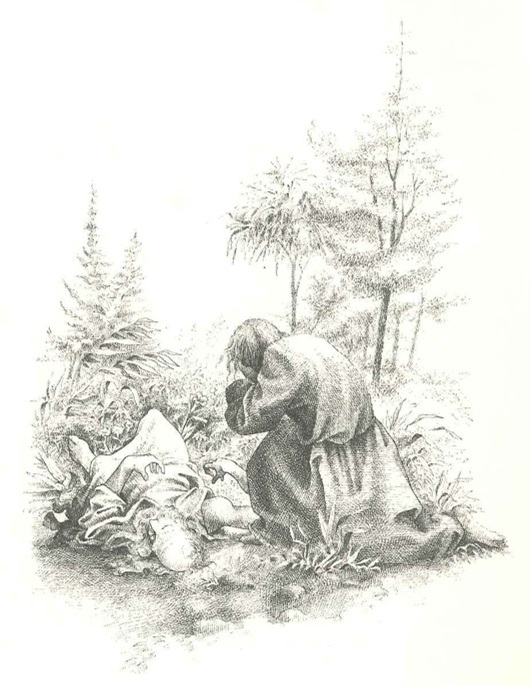
One day there came into the Garden a man in torn clothes badly bruised and cut, who said to the Lover, “In the name of the Beloved I demand your help.”
So the Lover and the Disciple let him in and dressed his wounds and prepared the best of the vegetables from the Garden for him to eat. When his wounds had been dressed and he had eaten and rested the Lover asked him how he had fallen into this plight, to which the man replied, “I was Minister of the Beloved in a city near this place, where I preached His gospel and expounded His doctrine to the people. I pointed out to them how their sins had made them wholly hateful to the Beloved and how therefore they were utterly beyond the range of His love and He would condemn them to eternal torments, whereon some fell into despair and wept bitterly but many were angry. One day the magistrates called me before them and begged me to leave the city and preach elsewhere for they said I had made many people so angry and desperate that they feared there might be a riot and they might not be able to protect me but that I might suffer some injury. I, however, very zealous for the Beloved and believing that the magistrates only feared that their own sins might be proclaimed, preached the more vehemently, denounced the magistrates and made it abundantly clear that the whole wicked city was foredoomed to eternal punishment by the just provision of the Beloved. Whereon a mob, stirred up no doubt by the corrupt and venal magistrates, fell upon me with sticks and stones, nearly killing me and driving me out of the city in the state in which I came to you.”
“My friend,” said the Lover, “this was not a good deed of yours, for besides denying the unfathomable compassion of the Beloved, you have by your obstinacy caused these people to commit a grievous sin, and this cannot be pleasing to the Beloved, that through you who profess to be His minister the people should become worse. Surely you remember that He Himself said, ‘If they persecute you in one city flee to another.’”
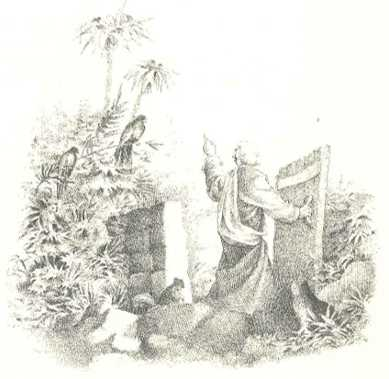
Therefore the man was very angry, and cursing the Lover, said, “I see that I have had a very false report of you and I do not believe that you are a servant of the Beloved at all. When I came to you so injured for the Beloved’s sake you set before me only herbs and fruits although the garden is full of birds which you could have killed to make me a worthy meal. I shall proclaim everywhere that you are no true servant of the Beloved but a mere falterer who dares not suffer in the cause of the Beloved. Be sure that you are foreordained to eternal torments who suffer nothing here.”
For the man was so blinded by his own pride that he could not perceive the scars on the hands and feet and the brows of the Lover nor how the cloth beneath the armpits of his tunic was dyed with a red dye. So he went out of the Garden cursing and shouting.
But the Lover looked sad and said, “A man like this does much harm to the cause of the Beloved, for by thus speaking falsely about the Beloved he may bring men to fear Him but none to love Him, and by love alone can any man approach the Beloved.”