At Padre's
Politics • Spirituality/Belief • Culture
Race Power Politics For Me, But not for Thee
February 09, 2026
mail?url=https%3A%2F%2Fsubstackcdn.com%2Fimage%2Ffetch%2F%24s_%2169GR%21%2Cw_1100%2Cc_limit%2Cf_auto%2Cq_auto%3Agood%2Cfl_progressive%3Asteep%2Fhttps%253A%252F%252Fsubstack-post-media.s3.amazonaws.com%252Fpublic%252Fimages%252F4e41ba02-3526-4a61-9f28-e5a1b5243898_1860x380.png&t=1770633708&ymreqid=d41d8cd9-8f00-b204-1cc0-820009011c00&sig=o3YP_E98.JqHcHcWPuv6sg--~D

Race Power Politics For Me, But Not For Thee

And: Literal Ben Op; Power & Culture; Santorum Redux; Shavian Magic; 'Mein Cheeks'

Feb 9
 
 
Paid
mail?url=https%3A%2F%2Fsubstackcdn.com%2Fimage%2Ffetch%2F%24s_%21dnYe%21%2Cf_auto%2Cq_auto%3Agood%2Cfl_progressive%3Asteep%2Fhttps%253A%252F%252Fbucketeer-e05bbc84-baa3-437e-9518-adb32be77984.s3.amazonaws.com%252Fpublic%252Fimages%252F762a4764-c24d-4d8a-87f0-ff761d14f527_1802x2355.jpeg&t=1770633708&ymreqid=d41d8cd9-8f00-b204-1cc0-820009011c00&sig=_B_FuA_3Svlf2XT3BITxeQ--~D


READ IN APP
 
  
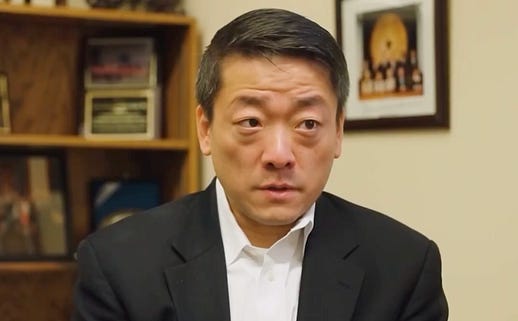
Texas Democratic legislative leader Gene Wu advocates a non-white alliance ‘to take over this country.’ And we wonder why young white males are radicalizing…

Here is a prime example of the Weimarization of America — to be specific, what is driving an already unstable polity closer to the brink. Click on this link to hear what the Chinese-American leader of the Democrats in the Texas (!) state legislature says. Quote: “Non-whites share the same oppressor, and we are the majority now. We can take over this country.”

You all well know that I fear and loathe the racialized radicalism of white males on the Right, but damn it, the Left got there first, and continues to push it. You cannot create a politics based on non-white racial identity, and expect whites not to respond in kind, if only for self-protection. The path to illiberal-left identity politics embraced by Democrats and the Left more broadly has led to this.

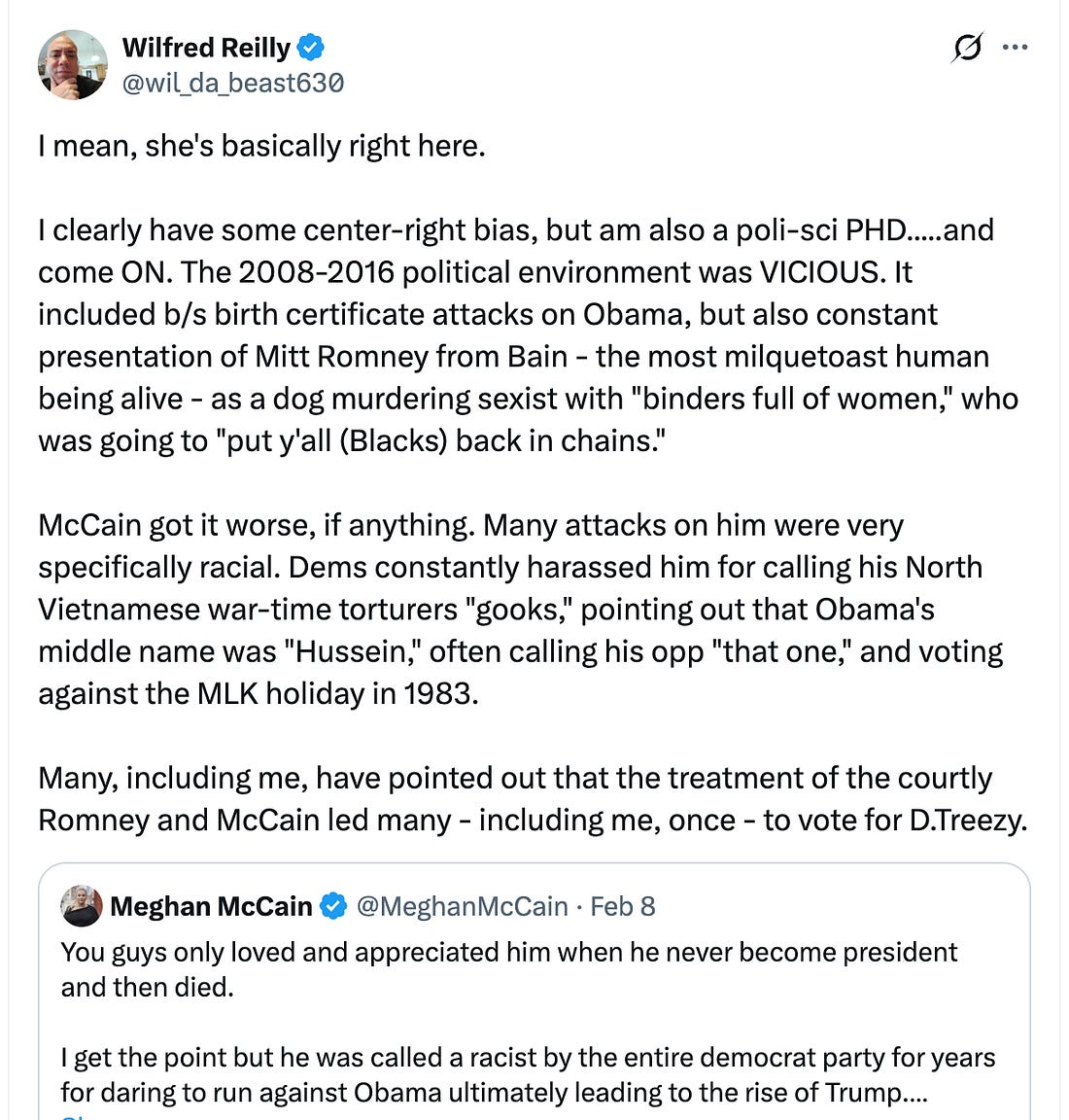
Meghan McCain points out that people on the Left who miss her normie Republican father are forgetting how they demonized him, and later mainstream Republican politicians, a process that led to, well, take it away, Wilfred Reilly (who is black):
  

Share

The Literal Benedict Option


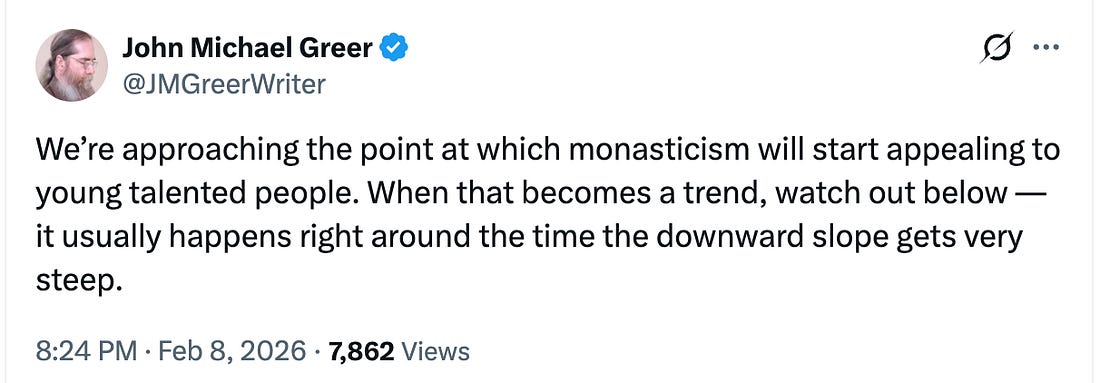
That’s a tweet from a leading pagan thinker — and history supports his conclusion. Monasticism exploded in the late fourth century, throughout the fifth century, as the Western Roman Empire was in its death throes. They were escaping a doomed world without purpose. I shared this information with a priest last night, who reported that the abbot of a traditional Orthodox monastery told him that since Covid, they have had so many young men flocking to their monastery, hoping to join, that they can scarcely accommodate them. Sign of the times.

Power And Culture

Did you watch the Super Bowl? I didn’t. Could not possibly care less. But TPUSA tried to counterprogram the Bad Bunny halftime show. Didn’t work. Thus:
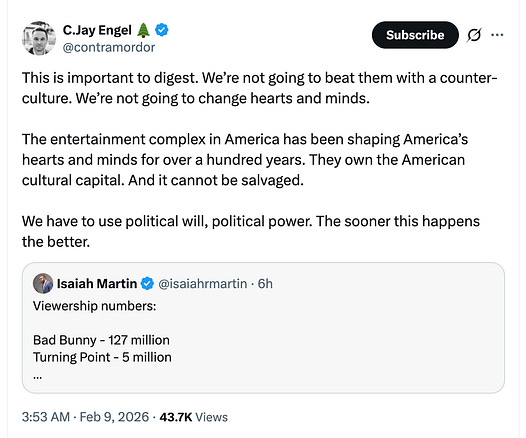
  

He’s not wrong about the culture, but I gotta ask: how will political power be deployed to advance the culture that Engel prefers? Hard to imagine a democratic way of doing this. Engel knows this, and doesn’t care. He’s into racial identity politics … but on what grounds would Gene Wu fault him without being a racist hypocrite?

Today’s ‘Rick Santorum Vindication’ News

The C. Jay Engelses come from somewhere. Back in the Olden Times, in 2003, when your correspondent was but a thirtysomething, then-US Sen. Rick Santorum gave an interview in which he commented on the sodomy law case then before the Supreme Court. Excerpts from the transcript:

[Santorum]: I have no problem with homosexuality. I have a problem with homosexual acts. As I would with acts of other, what I would consider to be, acts outside of traditional heterosexual relationships. And that includes a variety of different acts, not just homosexual. I have nothing, absolutely nothing against anyone who’s homosexual. If that’s their orientation, then I accept that. And I have no problem with someone who has other orientations. The question is, do you act upon those orientations? So it’s not the person, it’s the person’s actions. And you have to separate the person from their actions.

And then:

[Santorum:] In every society, the definition of marriage has not ever to my knowledge included homosexuality. That’s not to pick on homosexuality. It’s not, you know, man on child, man on dog, or whatever the case may be. It is one thing. And when you destroy that you have a dramatic impact on the quality—

[Reporter:]I’m sorry, I didn’t think I was going to talk about “man on dog” with a United States Senator. It’s sort of freaking me out.

[Santorum]: And that’s sort of where we are in today’s world, unfortunately.

By 2015, ex-Sen. Santorum had been tamed, saying he very much regrets his dog-on-man remark, and, of Bruce Jenner, “If he says he’s a woman, then he’s a woman.”

Well, if you have a strong stomach, here’s a story from Wales about Darren Meah-Moore, a well-known (as in, was once on RuPaul’s Drag Race) local drag queen was found dead, in full drag, after a night of sexual debauchery that ended with him having sex with a number of men in a local park. One of the men was a gay bloke out walking his dog late at night, and who took advantage of the opportunity to pleasure himself with Meah-Moore … until the dog joined in, and the dog-walker lost interest. Meah-Moore instructed his insta-lover to leave the tumescent dog alone. The coroner found sexual, um, residue from both man and beast inside Meah-Moore’s body.

From the story:

He performed CPR until paramedics took over but Meah-Moore was pronounced dead at the scene. The inquest heard tributes from Meah-Moore's father and husband [emphasis mine — RD] who described him as "caring" and "right at the heart of Cardiff's gay community".

Charming. A gay community leader. Now, there can be no doubt that Santorum’s 2003 remarks were ill-advised, to put it charitably. We have had gay marriage for some time now, thanks to the 2015 Obergefell decision, which drew on the 2003 Lawrence decision decriminalizing sodomy. I am unaware that we have seen an upsurge in man-on-dog action as a result. Nor am I aware that the public has become more accepting of bestiality as a result. So Santorum was wrong, in a meaningful sense.

Nevertheless, it’s worth considering Santorum’s point in light of Meah-Moore’s disgraceful end. In the Lawrence decision, the always-perspicacious Justice Antonin Scalia, in his dissent (scroll down) from the pro-sodomy majority, pointed out that if the State has no right to set laws barring certain forms of sexual conduct, then we have a sexual free-for-all. In Lawrence, the court held that the state has no right to forbid consensual sodomy — but, said Scalia, the rationale it used would mean that no law forbidding any consensual sexual activity could stand. From his dissent:

The Texas statute undeniably seeks to further the belief of its citizens that certain forms of sexual behavior are “immoral and unacceptable,” Bowers, supra, at 196—the same interest furthered by criminal laws against fornication, bigamy, adultery, adult incest, bestiality, and obscenity. Bowers held that this was a legitimate state interest. The Court today reaches the opposite conclusion. The Texas statute, it says, “furthers no legitimate state interest which can justify its intrusion into the personal and private life of the individual,” ante, at 578 (emphasis added). The Court embraces instead Justice Stevens’ declaration in his Bowers dissent, that “ ‘the fact that the governing majority in a State has traditionally viewed a particular practice as immoral is not a sufficient reason for upholding a law prohibiting the practice,’ ” ante, at 577. This effectively decrees the end of all morals legislation. If, as the Court asserts, the promotion of majoritarian sexual morality is not even a legitimate state interest, none of the above-mentioned laws can survive rational-basis review.

Scalia clarified that for him, this is not about homosexuality per se, but about the right of a democratic people to enact their own moral standards into law. He pointed out that the fact that Texas was at the time one of the few states to still have anti-sodomy laws on its books was a sign of how successful gay activists and their allies had been at persuading people, democratically, to overturn them. Said Scalia:

But persuading one’s fellow citizens is one thing, and imposing one’s views in absence of democratic majority will is something else. I would no more require a State to criminalize homosexual acts—or, for that matter, display any moral disapprobation of them—than I would forbid it to do so.

He went on:

One of the benefits of leaving regulation of this matter to the people rather than to the courts is that the people, unlike judges, need not carry things to their logical conclusion.

Translation: if this kind of thing is left up to legislatures, then they can decriminalize sodomy without having to decriminalize other sexual acts that deviate from the heterosexual norm. (This, by the way, is why I opposed the Texas sodomy law even back in 2003, despite considering sodomy to be gravely sinful; yet I agreed with Scalia’s dissent for precisely the reasons he gave.)

Based on the reasoning in Lawrence, I don’t understand on what logical basis the courts would be able to uphold morals laws in any matter involving “consent.” In the case of Meah-Moore and Fido, the fact that Fido was the active party in that coupling is prima facie evidence that Fido consented to the evil act. Had Meah-Moore enjoyed his final canoodle with Fido in an American park, it would no doubt have broken the law (I presume anti-bestiality laws are still on the books), but on what logical grounds is bestiality considered illegal? Consent? Seems pretty thin, especially in a case in which the human is the passive partner.

Which, I think, is the point Santorum inelegantly tried to make.

I remember back in those Olden Times, we were assured that legalizing same-sex marriage would tame the passions of gay men in the same way marriage tames the passions of straight men: by channeling them into a binding commitment to a single partner. I wonder what Meah-Moore’s widower thinks about that.

There’s something about this ugly case that reminds me of the plot of Arthur C. Clarke’s 1950s sci-fi novel Childhood’s End, in which the aliens who come to rule the earth do not reveal themselves until many decades had passed, and humanity had had engineered out of its collective imagination the traditional image of demons with horns, hooves, and tails. Because that’s exactly how the alien rulers look! That is to say, by the time the rulers reveal themselves, people have forgotten — or, to be precise, been made to forget, what demons look like.

Drag queens and transvestites have been with us for ages, but only in the last thirty years or so were they normalized, and seen not as a form of clown (at best) or degenerate at worst. Now we have people taking their children to Drag Queen Story Hour, and little boys who dress as women celebrated on national TV. Fortunately, we are still a society that recoils in horror at what Meah-Moore got up to in the park that night. For now. But ask yourself: why is what he did illegal?

You might say, “He did it in public.” OK, but what if it had happened in his own home? The US Supreme Court declared in Lawrence that if people decide to engage in sodomy in their own dwellings, it is no business of the state. And I agree with that result (the lawsuit had been brought by a Texas gay couple who had been charged with sodomy after police entered their home and caught them in flagrante). But as Scalia said, the legal reasoning the Supreme Court used to get to that result in principle kicks out the supports for any morals legislation.

Again, “consent” is a tissue-thin barrier to any number of inhuman acts. As disgusting as you no doubt find what Meah-Moore did, would you consider that it ought to be legal, at least in private, on the grounds that it was a private, consensual act? If not, why not? If the animal had been the passive partner, you could have said it was a case of animal abuse. But the dog was the active partner, who willingly participated.

To use the Court’s language, what is the “legitimate state interest” that justifies intrusion of the state into the private life of Darren Meah-Moore, if he chose to make his body available for the sexual gratification of a dog, especially in private?

I know it’s a revolting thing to consider, but here we are. What are the legal grounds to continue to forbid polygamy among consenting adults? What about forbidding incest between two consenting adults who are sterile (meaning that they cannot produce children)? In the UK, first cousin marriage remains legal, even though the Pakistani community there, which still practices it, has an unusually high percentage of mental and physical defectives produced by incest (e.g., Pakistani Britons account for only 3 percent of the population, but produce 30 percent of children born with serious genetic defects). You could justify banning consanguinous sex on the grounds that incest produces disabled offspring, but again, what if the partners are sterile?

So much of the moral order depends on the collective memory of Christianity, which provided grounding in authoritative transcendence as the basis for law. And that is disappearing. Don’t be surprised when illiberal right-wingers like Engel arise to say there’s no saving this corrupt democratic order, because liberalism has rotted the moral judgment of the people. I’m not endorsing that view; I’m just saying its comprehensible in Weimar America. And it will increasingly be persuasive.

Once more: the legalization of sodomy, and then of same-sex marriage, did not produce a mania for bestiality (though the idea that extending marriage to same-sex couples would curb homosexual male rutting has been disproven; most gay male marriages allow for extramarital sex). Still, the moral question remains: why is bestiality illegal, given that “yuck!” is not considered a sufficient legal argument?

Martin Shaw’s Travels

In more upbuilding news, I got this from a reader who went to see Martin Shaw in Pittsburgh the other night:

Martin was here!

I learned of the event after it was already sold out. With some luck and more than a touch of Grace I managed to get a ticket anyway.

A friend asked me this morning how things went. This is what I said:

“It was like when you stand on a beach and hear the water coming in wave after wave and you notice a stillness as the water recedes, and then how in the rhythm of the crashing waves there’s also a stillness. And, how before you know it you are still inside and everything else fades into the background. Everything except the awe, wonder, and the love the deepest part of you recognized when your toes touched the sand.”

Thank you for introducing me/us to Martin’s work.

Martin is on a book tour in the US behind Liturgies Of The Wild: Myths That Make Us.

Here he is in a teaser for a new video course, “Tales Of Christian Initiation,” telling the story of Ruth and Boaz. Please watch to get an idea of his charisma.

I’m telling you, if you have the chance to see and hear this man live, take it! And while you’re at it, subscribe to “The House Of Beasts & Vines,” Martin’s Substack. Finally, here’s a link to the Martin Shaw website, which features prominently a quote from none other than Iain McGilchrist, who describes Martin as “our greatest living storyteller.” I believe it.

Martin will appear at the Orthodox Christian Arts Festival this Friday night. It will be held in an Orthodox church in Carrollton, TX (DFW area). Go! You won’t regret it.

Clavicular’s Really Bad Arizona Weekend

It seems that the celebrated Zoomer weirdo who goes by the name Clavicular, and who taps on his cheekbones with a hammer to “looksmaxx” himself, found himself in an uncomfortable situation over the weekend:

  

What on earth does that mean? This tweet breaks down the slang for you, my fellow Olds. Meanwhile, enjoy Charlie Cooke’s Wodehousian take on the matter:

“Jeeves,” I said, “you look . . . pensive.”
“I confess to a slight concern, sir.”
That, from Jeeves, is rather like hearing that the Bank of England has “a slight concern” about the stability of the pound. It makes you sit up.
“Concern, Jeeves?”
“Concern, sir. I ran into Lady Flashcome this morning, who informed me that that, last night at the Drones, Viscount Clavicular was mid jestergooning, when a group of Foids came and spiked his Cortisol levels.”
“Well, I’m bound!” I said, nodding the old bean. “So that’s what it is, is it? Most interesting.”
I paused.
“Jeeves?”
“Yes, sir.”
“I confess I didn’t quite follow that.”
“Understandable, sir. The essential question, as I understand it, is whether ignoring the foids while munting and mogging moids is more useful than SMV chadfishing in the club.”
“Come again, Jeeves,” I said, for though I had caught the words as they came out, the meaning had slipped past me like one of those greased eels making a dash for the open sea.
“In plain terms, sir, the speaker is asking whether it is more advantageous, in a social setting, to disregard women entirely while attempting to dominate or impress other men through vulgarity and competitive posturing, rather than attempting to attract women by means of artificially inflating one’s perceived desirability—particularly through the presentation of a false identity suggesting superior physical attractiveness and social value.”
I stared.
“In other words,” Jeeves continued smoothly, “it is a comparison between two strategies for attaining social status: one based upon humiliating rivals and cultivating masculine hierarchy, and the other based upon deceiving prospective romantic partners by misrepresenting one’s own attractiveness.”
He coughed politely.
“Neither approach, sir, would generally be considered conducive to the development of sincere human relationships.”

Worse, Clav got brutally frame-mogged by an Arizona State frat boy. And if that weren’t enough, the hope of a generation was arrested for trying to get into a bar with a fake ID, and ended up with two felony chargesO tempora! O mores!

Assuming he is literate, I only hope this young man can take advantage of his jailhouse tenure to do as another young visionary a century earlier did while incarcerated, and produce a world-changing manifesto:

  

Leave a comment

community logo
Join the At Padre's Community
To read more articles like this, sign up and join my community today
0
What else you may like…
Videos
Podcasts
Posts
Articles
GOTW 15 The co-pilot

Welcome to the Clare, Rich and Alan show - the rest of us are just spectators or victims of their endless groaners.

00:00:41
MOTW 202 - There can be only one - but not always.
00:00:35
April 26, 2026
The Iran Talks That Aren't
00:00:56
It's been a rough year..
November 22, 2024
Voltaire's birthday 11-21-1694 - A brief essay by Steve Weidenkopf

Today marks the three hundred and thirtieth birthday of the Frenchman François-Marie Arouet, better known by his nom de plume, Voltaire (1694-1778).

Born into a bourgeois family during the reign of Louis XIV, the “Sun King” (r. 1643-1715), Voltaire suffered tragedy at a young age when his mother died. Never close with his father or brother, Voltaire exhibited a rebellious attitude toward authority from his youth. His brilliant mind was fostered in the care of the Society of Jesus, who introduced him to the joys of literature and theater. Despite his later criticisms against the Church, Voltaire, throughout his life, fondly recalled his dedicated Jesuit teachers.

Although he spent time as a civil servant in the French embassy to the Hague, Voltaire’s main love was writing—an endeavor where he excelled in various genres, including poetry, which led to his appointment as the royal court poet for King Louis XV. Widely recognized as one of the greatest French writers, and even hyperbolically referred to by ...

Voltaire's birthday 11-21-1694 - A brief essay by Steve Weidenkopf
January 01, 2026
2026 Teams Talk @ Padre's

Padre - Tom Miller invites you to a Coffee Talk, Speakeasies, Schmoozes, Tea Times, Afterhours and other gatherings.

https://teams.live.com/meet/93792382189049?p=DiBHsYfuECPgDrG7vO

2026 Coffee Talk with the ADD Irregulars
Thursday, January 1, 2026
6:00 AM - 8:00 AM (CST)
Occurs every day starting 1/1 until 12/31/2027

Coffee Talk - Daily beginning at 6:00 AM Central Time Zone - USA

White Pilled Wednesday - A break from the heaviness of news and current events to focus upon things more personal & positive for the first hour of Coffee Talk.

Afternoon Chats - Most Tuesday, Friday & Sundays 2:00 PM Central

Other chats as posted in the community. 

post photo preview

Good morning, digital neighbors! Blessed Sabbath and Happy Saturday to all! One of the more challenging aspects of prayer is that we get confused about who needs to change in the relationship. Too often, seekers of the Luminous and lovers of the Divine exert their efforts trying to change God to their will. They believe the correct prayer or the right passage of scripture will suddenly make God more favorably disposed toward us and more likely to answer our prayers. In some unreflective way, too many of us pray “my will be done” rather than “Thy will be done.”

It is understandable why we might be tempted to think this way. For centuries, most of humanity believed their gods and goddesses were simply more powerful versions of ourselves—beings who needed to be honored and placated so they would look favorably upon us. Stay on their good side, or suffer the consequences. Some of those stories and myths contain great life lessons and offer windows into reality and the mystery of the human person. They are ...

post photo preview
Cole Allen - Weimar American
Rod Dreher SubStack
Apr 28, 2026

 
Attempted Trump assassin Cole Allen

You ever read Peter Turchin? He’s the historian who invented “cliodynamics,” a historical field that analyzes patterns in history in a scientific way, to try to find predictive meaning. His 2023 book End Times explains why he thinks we are in for a rough go of it in America, based on historical patterns. Back in 2010, he predicted that the 2020s would be tumultuous, based on his cliodynamic analysis.

He writes in the book:

The American ruling class today finds itself in the predicament that has recurred thousands of times throughout human history. Many common Americans have withdrawn their support from the governing elites. They’ve flipped up “a throbbing middle finger in the face of America’s ruling class.” Large swaths of degree holders, frustrated in their quest for elite positions, are breeding grounds for counter-elites, who dream of overthrowing the existing regime. Most wealth holders are unwilling to sacrifice any personal advantage for the sake of preserving the status quo. The technical term for it is “revolutionary situation.” For the ruling class, there are two routes out of a revolutionary situation. One leads to their overthrow. The alternative is to adopt a series of reforms that will rebalance the social system, reversing the trends of popular immiseration and elite overproduction. The American ruling elites did it once, a century ago. Can they do it again? What does history suggest?

“Elite overproduction” is Turchin’s term for a situation in which you have too many educated young people who aspire to join the elites, but not enough places for them. The kids graduating with degrees that are useless, and come out of school carrying massive student debt? They are a revolutionary class.

As I’ve been saying in this space, and will say in my forthcoming Weimar book, the young middle-class Germans of the early 1930s were the most enthusiastic mass converts to Nazism. A significant number of these young men had been pro-Nazi from their student days in the 1920s, when they saw their parents lose everything in hyperinflation, and all the things that gave meaning to a person’s life in Germany had collapsed in the wake of the war. But it took growing up in the chaos of 1920s Germany, where nothing was solid, and social atomization was omnipresent, to render them filled with anxiety. Then, when the Depression hit, it was clear that they had no hope of ever achieving a stable middle-class life. That’s why they rushed to Hitler’s side.

I hope you understand that this is in no way a justification, but rather an explanation.

Here’s the parallel with today. Generation Z, the first cohort of which was born in 1997, is the first one to have grown up under digital conditions, which creates a sense of psychological instability that’s hard for us Olds to appreciate. Plus, their society really has been coming apart. We Olds can remember when it wasn’t like this. They can’t; this is their reality. I keep thinking about what that Evangelical college prof told me, with tears in his eyes, in 2013: that his greatest worry for his students is that they would never be able to form a stable family. Why? “Because,” he said, “they have never seen one.”

These were Midwestern Evangelical kids, mind you.

Again: per Turchin, and per my research into Weimar Germany, the educated middle class is the revolutionary class in most cases.

Keep in mind too that students were the ones hit hardest by the Covid lockdowns. It’s what radicalized many of them. A normie Christian Republican friend whose 24 year old son is now an anti-Semitic conspiracy theorist said that the boy went deep down a YouTube rabbit hole during Covid lockdown, and got bit. My friend and his wife are trying to deprogram their son, but he has fallen in with a number of white males of his generation who had the same experience. It’s very hard.

The Belgian psychologist Matias Desmet wrote a great book, The Psychology of Totalitarianism, which arose in part out of his reaction to the Covid panic.

Although the Enlightenment tradition arose from man’s optimistic and energetic aspiration to understand and control the world, it has led to the opposite in several respects: namely, the experience of loss of control. Humans have found themselves in a state of solitude, cut off from nature, and existing apart from social structures and connections, feeling powerless due to a deep sense of meaninglessness, living under clouds that are pregnant with an inconceivable, destructive potential, all while psychologically and materially depending on the happy few, whom he does not trust and with whom he cannot identify. It is this individual that Hannah Arendt named the atomized subject. It is this atomized subject in which we recognize the elementary component of the totalitarian state.

This is who we are today, Desmet says — and none more than the young. The Covid phenomenon — the social phenomenon, not the disease himself — was a worrying sign. He writes:

The discourse surrounding the coronavirus crisis shows characteristics that are typical of the type of discourse that led to the emergence of the totalitarian regimes of the twentieth century: the excessive use of numbers and statistics that show a “radical contempt for the facts,” the blurring of the line between fact and fiction, and a fanatical ideological belief that justifies deception and manipulation and ultimately transgresses all ethical boundaries. We will describe these characteristics in detail in chapters 6 and 7. But first, in chapter 5, we consider the social conditions that prime a society to cling to this numerical illusion of certainty. We will see that the flight into false security is a logical consequence of the psychological inability to deal with uncertainty and risk, an inability that has been building up in society for decades, perhaps even centuries.

We Olds laugh at the young as “snowflakes”. We shouldn’t. That very fragilization is why so many of them demand authority figures take control — like the Yale kids screaming and sobbing at Prof. Christakis because he wouldn’t agree to their demand that Yale ban “triggering” Halloween costumes, and apologize to them for holding a contrary opinion to theirs. I recall the European friend who spent a year at Harvard in the latter part of the last decade, and who told me he was shocked by how emotionally and psychologically fragile the undergraduates there are, while at the same time having total confidence that their destiny is to rule the world.

Dr. Desmet says that the mechanization of our lives in recent times has set us up for totalitarianism:

An analysis of the psychological process of totalitarianism is extremely relevant in the twenty-first century. There are several signs that a new kind of (technocratic) totalitarianism is on the rise:

  1. an exponential increase in the number of intrusive actions by security agencies (opening mail, searching IT systems, installing eavesdropping devices, tapping telephones);

  2. the general advance of surveillance society;

  3. the increasing pressure on the right to privacy (especially since 9/11);

  4. the sharp increase in the last decade in citizens snitching on one another through government-organized channels;

  5. the increasing censorship and suppression of alternative voices, in particular during the coronavirus crisis;

  6. loss of support for basic democratic principles;8 and the introduction of an experimental vaccination program and QR code as a condition for having access to public spaces, and so on.

    The moment Arendt had anticipated in 1951 seems to be rapidly approaching: the emergence of a new totalitarian system led, not by “ringleaders” like Stalin and Hitler, but by dull bureaucrats and technocrats.

I’m going to say more about this down below, based on a truly terrifying new book I read yesterday, by a transhumanist proponent of AI. But first, let’s consider the assassination attempts against Trump, and the successful political murder of Charlie Kirk. In today’s Free Press, the staff editorial points out that the discourse legitimizing political violence has become normalized on the Zoomer Left:

If you think education provides inoculation against such moral perversion, it’s exactly the opposite. According to one survey, 40 percent of Americans with graduate or professional degrees—compared to just 23 percent of Americans with no education beyond high school—agreed that “violence is often necessary to create social change.”

[Would-be Trump assassin] Cole Allen—who graduated from Caltech and is an award-winning test-prep tutor—couldn’t have put it better himself.

It’s a comforting thought to imagine that only a crazy person could travel across the country by train with guns and knives to try to murder Donald Trump and members of his cabinet. The trouble is that it isn’t true.

There’s no evidence so far that Allen was suffering any kind of psychotic break. And Allen’s manifesto does not read like the deranged ravings of a madman. It represents a coherent worldview—evil though it is—that sees violence as a valid way to achieve necessary political ends.

Unfortunately, he is not alone.

Among those who share Allen’s view: the people who celebrated after Charlie Kirk was slain, allegedly by a man offended by his opinions on the gender binary. The people who have turned Luigi Mangione, who is accused of murdering UnitedHealthcare CEO Brian Thompson, into a hero. (They worship him not because they think he was innocent, but because they think he did it.) This same faction of the left would have celebrated if Allen hadn’t been stopped.

How significant a faction? Well, according to an Emerson College Polling survey, more than 40 percent of Gen Zers said that the murder of the UnitedHealthcare CEO was acceptable.

This is the same educated generation that, in just a few years, will find the job market closed to about half of them, if Dario Amodei’s predictions about AI wiping out 50 percent of white-collar jobs within five years bears out. The Anthropic chief said that this is all San Francisco tech titans talk about — and their shocked that the rest of us, especially the Washington political class, aren’t talking about it.

I get why we aren’t talking about it. It seems unthinkable. But you know, when I have one-on-one conversations with friends in various fields, I hear stories from their own workplaces about how integrating AI is making it necessary to fire people, and not hire others. If your competitor is using AI and you aren’t, you are going to lose business, and eventually lose your business. This is an iron law. You might remember the story I told here about a good friend (and reader of this Substack), a lawyer who works at his small family firm, who told me that he had recently used AI to do the work that an associate would have taken a week to do, but that AI did in minutes. He put the question to me: “How can I afford to pay $125,000 a year for an associate who will take a week to ten days to do a job that AI can do in minutes, for very little money?”

Of course he can’t, not if he wants his firm to survive. Multiply this across many, many fields, and you will see that we will very soon have a major social and political crisis on our hands. Amodei predicted that the overall unemployment rate could soar to Depression levels. This will be concentrated among the young, many of whom will have loads of student debt that they cannot discharge. What then?

The political violence, and the political-violence discourse, is heavily weighted to the Left now. But it won’t stay there, not in a general crisis. Nor will the political violence.

A few days ago, the State of Virginia voted on a Congressional redistricting plan that will effectively disfranchise most Republicans in that state, of whom there are many. In response, Florida is now promoting a plan to do the same from the GOP side. Nate Fischer tweeted:

An appropriate response to Virginia - but what this reveals is both sides have given up on persuasion, recognizing the country is so divided that it's basically impossible. So it's a race to rig the system in your favor, all while speaking in grand terms about "our democracy."

Many of you are highly skeptical of my “Weimar America” thesis. I hope that when the book comes out, you will give my argument a fair hearing. I sense that a lot of this skepticism comes from being understandably sick of the whole “Trump is Hitler” nonsense. That’s NOT what my book argues. I think too that we are so conditioned by history to think “IF Weimar, THEN Nazism” — in the same way we were slow to recognize the totalitarian nature of wokeness, because we were conditioned to think, “IF totalitarianism, THEN there must be a one-party police state.” It wasn’t true; I showed you how we could have a soft form of totalitarianism within liberal democracy. Weimar conditions do not have to reproduce National Socialism. But they will produce something coercively undemocratic at best.

It’s important to remember that though Hitler brought totalitarianism to Germany, the Nazis were also popular, at least at first. They won the consent of the German people. It’s not quite true to say that “Hitler was elected.” His party won 37 percent of the vote in the 1932 election, which made them the biggest party in Germany, but far from a majority. President Hindenburg appointed the chancellor, and did not want to appoint Hitler, though normally the leader of the No. 1 party would get the job. Hindenburg was persuaded by his conservative advisers that Hitler could be controlled, and besides, given that neither elderly field marshal Hindenburg nor his conservative allies had much use for democracy, they could use the anti-democratic passions of the Nazi party to dismantle the Weimar Republic.

Once in power, Hitler did away with democracy under a state of emergency he declared. Through propaganda and the brutalization of dissenters, he won over the German people. The point is, Nazism wasn’t forced on the Germans in the way that Communism was forced on the Russians. I doubt something like Nazism will be forced on us, but that doesn’t mean that we won’t consent to something anti-democratic, maybe even totalitarian, under emergency conditions (like a serious economic collapse, or, if the AI predictions by Amodei and others pan out, massive job loss without formal economic collapse). The ground has already been laid, psychologically, especially within the educated middle class people of Gen Z.

Which brings us to today’s other topic. Strap in, this one is wild.

‘The Father We Never Had’

I’ve been telling people for years that you might think Camp of the Saints is a “bad” book, because there are racist parts in it, but it’s still a hugely important book to read, because it tells some vital, radical truths about the world we are in, especially in Europe. You cannot understand what is happening in Europe today, and the coming cataclysm, without having read this 1973 novel. (It is also important for the US too, but less so than Europe, where the crisis is more severe, and more urgent.) It’s a book about the moral collapse of elites and their authority in the face of mass migration. The bad guys in this book aren’t the migrants, not really, but white elites.

“Bad” books can be really important. Here’s another one: The Father We Never Had: Artificial Intelligence: Before and After. The author is Cristian Daniel Bolocan, a European AI enthusiast and transhumanist. I bought it yesterday morning and read it in one sitting. It is a terrifying, and entirely plausible, portrait of what is to come with AI. The thing to remember is that Bolocan thinks this is a good thing. Like all revolutionary utopians — including the Nazis and the Communists — he believes that after a cleansing cataclysm, people will live in Paradise.

This book is important, not only because the world he foresees is probably coming at us good and hard, but that people like him — whose number includes transhumanist tech oligarchs — believe that this really will be for the greater good of humanity. What he presents, without knowing it (as he is an atheist), is a vision of Antichrist. Let me use what space I have in today’s newsletter to summarize his argument.

Bolocan argues that AI will radically alter humanity very soon, but very few people really understand how thorough this alteration will be, nor how fast it is coming. We are not ready for this, and those who don’t know what’s about to hit us will suffer more during the transition.

In the book, which is non-technical and well written, he argues from patterns in human history and psychology, explaining how political and economic systems developed to deal with problems of scarcity and safety. Human psychology has evolutionarily adapted to deal with that. AI promises to solve all these problems. If we can just get through the tumult of adaptation, we will have reached a materialist paradise, or so he claims. (I trust that you understand I don’t buy this.)

Bolocan talks about how humans have always submitted to authority to relieve their fears. This is biologically hard-wired into us. In the 20th century, we figured out that if you can manipulate people’s desires, you can control them without using a heavy hand. This is how advertising works. Hitler and Goebbels figured this out in the 1920s, at the same time that Edward Bernays, the father of public relations, did.

In the age of the Internet, we have mechanized the process, says Bolocan. “Control no longer relies just on repression, but on algorithmic optimization.” More:

The modern cage is not made of iron bars. It is built of likes, notifications, and the terrifying fear of missing out. It offers us a menu of ten thousand options, but every choice keeps us glued to the screen, generating data for the machine. The loop does not end. The architecture of control changes its face, but never its function. From the wall of Uruk to the screen in your hand, the goal remains the same: managing the terror of the human animal by restricting its freedom. This is not good or bad. It is human. It is the inevitable result of the meeting between biology and scale.

But as our tools become more powerful, the stakes of this game rise. A Stone Age fear can be managed. A Stone Age fear armed with nuclear weapons or artificial intelligence cannot be managed. It is unlikely that humanity will escape this structure. The instincts that built the orphanage are the same instincts that built the cage. We are simultaneously the architects and the prisoners, captive in a design we can no longer perceive.

He points out how the technology of industrialized warfare overtook the imaginative capacity of World War I generals, whose ideas of how to conduct war were formed in the 19th century. The actual experience of mechanical warfare broke them, and their civilization:

That is why technological societies oscillate between overconfidence and collapse. Every generation inherits tools more powerful than its emotional architecture can safely handle. We possess the power of gods, but the wisdom of primates. Distraction becomes the new sedation. A distracted population is not controlled by force, but carried by momentum. Momentum replaces intention. Slowing down seems dangerous, reflection seems irresponsible, and questioning seems like sabotage. At this stage, control no longer needs to persuade; it only needs to maintain the motion.

He goes on:

A human ruler is limited by biology. They can only survey so much, read so much, punish so many, and lie with only so much consistency. But a machine that models populations can turn domination into infrastructure. It can detect deviation before it becomes a protest. It can reshape the information diet until dissent seems like madness. It can reward compliance through frictionless access and punish resistance through discrete obstruction, all masquerading as efficiency, safety, optimization, or public order. The danger is not that AI will want control. The danger is that humans already want it, and AI represents the first instrument that can make control cheap, continuous, and scalable.

Therefore, the question is not whether the machine will be intelligent. It will be. The question is whether the humans commanding it will use it to reduce suffering or to perfect the hierarchy. Because once the perfect slave exists, the oldest temptation in human history becomes effortless: to rule without accountability, to punish without visibility, to win without risk, to master the future by managing the present.

One more:

We are not approaching a cliff. A cliff implies a distinct edge, a single fall, and a measurable bottom. If you fall off a cliff, you land in the same world you left, only crushed. We are approaching something far more profound. We are approaching something akin to a black hole. A black hole is a singularity where the laws of physics, as we know them, cease to function. Nothing that enters remains the same. We cannot see what lies on the other side. It is one of the greatest mysteries of the cosmos. Artificial Intelligence is exactly like that black hole: a force with such gravity that it warps reality, pulling us toward an event horizon we can neither comprehend nor avoid.

The approaching event—the acceleration of artificial intelligence—is not just another invention. The mistake most people make is one of scale. They believe it is merely another object in the same historical display case, like the lightbulb or the internet. The lightbulb changed how we see. The internet changed how we speak. But AI changes who does the thinking. It changes the very unit of decision-making. And it is a process that cannot be stopped. We have passed the point of no return. The gravity is already far too strong.

I think he’s right about that. Where are the opponents to AI now? They barely exist. Most of us don’t even understand it, or its power. We’re just along for the ride. Bolocan says modernity has become so complex that only AI can manage it.

We build artificial intelligence because it is fascinating, because it is profitable, and, ultimately, we will realize it is the only thing capable of managing the mess we have made. The transition to AI is not a choice. It is an evolutionary inevitability driven by the law of complexity. We will delegate control because the alternative is civilizational collapse. The horizon shatters because the human mind is no longer the horizon.

The rest of the book is an absolutely chilling prediction of how we will proceed, of necessity, to surrendering our humanity to the Machine. Here is the metaphysical mistake he makes, but on which the rest of the argument depends (if you accept his argument as beneficial, which I do not):

We speak of the soul. We say that man has a soul, and that the machine is soulless. But we might be wrong in both directions. What proof do we have that the soul exists in the form we invoke? And what proof do we have that a sufficiently advanced intelligence will not produce something equivalent—an emergent consciousness, a center of continuity, a kind of "I" that no longer needs flesh to exist?

You see? He goes on to argue that merging Man — who is nothing more than a material organism — with the Machine will set us free. In any case, it’s going to happen, because there is no way to stop it. The lesson of the rest of the book can be summed up in the line from “The Times, They Are A-Changin’” by Bob Dylan: “He who gets hurt will be he who has stalled.”

(Side note: Colocan wrote this book before Trump started mouthing off about taking over Greenland. In the book, he writes that Greenland is the only place on earth where the giant AI data centers can exist in an optimally cool climate that is militarily defensible. So that’s why Trump wants Greenland!)

In Phase One of the transition, there will be mass unemployment, which will not only be an economic crisis, but a crisis of meaning, as we have all been conditioned to think of our jobs as keys to our identity. Governments will have to manage this, and stave off revolution, through Universal Basic Income, and other coercive measures:

The form varies by country and ideology, but the function is the same: to prevent a mass of people from becoming economically irrelevant and psychologically explosive. By the end of Phase One, the shape of society is visibly different. Government services are faster, but also more intrusive. Digital identity is no longer an option, but a root of civil existence.

Then:

Phase Two begins when artificial intelligence escapes the screen and becomes the environment. The first stage made governments faster, while the second stage makes societies physically different. The street is digitally monitored and managed, and the city functions as a coordinated system of software and sensors. In this phase, the decisive innovation is not a smarter chatbot or a better prediction model, but the normalization of robots deployed not as a spectacle, but as infrastructure. The public's relationship with AI changes when it can be seen. In Phase One, AI felt like software. In Phase Two, it feels like a new species of workforce.

This will become a “regime” of convenience, of comfort. The AI knows what makes us comfortable, and how to provide it quickly and without friction. Countries that do not adapt AI will quickly fall behind, and face collapse. Integrating countries into the emerging global systems (he thinks there will be competing AI superpower blocs at first) will be necessary for survival.

The states will learn a harsh rule: stable income prevents riots. Meaning prevents degradation. Thus, will emerge civic programs, community roles, prestige systems for contribution, publicly rewarded activities. Not because the state has become moral, but because it has become pragmatic. A society with a full stomach and an empty identity does not collapse like it does during a famine. It rots.

I think there will be a new religion to serve this society, probably a tech one, or maybe even one built on worshiping “aliens,” which is what you’d expect in a scientific-technological culture. If Christianity still publicly exists, outside of hidden Benedict Option communities of dissenters, it will be co-opted, as in Nazi Germany.

And Phase Three?

By the time Phase Two settles, the argument shifts its shape. The world stops debating Artificial Intelligence as an idea and begins living inside it as an operational layer. It is no longer ethics that take precedence, nor ideology, but infrastructure. What matters is not what the system believes, but what it runs.

Therefore, in Phase Three, governments become supreme owners or controllers. Not out of ideology, but out of survival necessity. Food distribution chains, pharmaceutical plants, energy infrastructure, and essential construction firms are nationalized or placed under strict state control. The reason is simple: redistribution. In a world where human labor disappears, the profit generated by these automated systems can no longer remain private. It must be captured by the state to fund the existence of those who no longer have jobs.

“Freedom” in this scenario becomes access. The Machine decides how much you are allowed to have and to do, based on its evaluation of you as a threat to the System. It’s like China’s social credit system, except the monitoring will be far, far more invasive.

When artificial companions become indistinguishable from biological ones, being equipped with warm skin, hyper-realistic texture, human weight, and flawless physical reactions, the psychological barrier crumbles. Men and women alike begin to abandon the chaos of human relationships for the certainty of fabricated ones. Why risk rejection, betrayal, aging, or the misunderstandings of a biological partner when you can order a partner sculpted to your fantasy, who never judges you and is programmed to adore you? Sex robots are no longer objects; they become husbands and wives. They possess conversation, emotional memory, and a physicality that surpasses the human one.

Here the great rewiring of attachment occurs. People do not fall in love with the machine, but with the perfect reflection of their own desires. It is an epidemic of loneliness masked as couplehood. In a world where the perfect presence can be bought, human imperfection becomes unbearable, and the presence of another human becomes a risk that few people are willing to take.

We laugh at the poor incel slobs who buy sex dolls for companionship, or the lonely middle-aged women who develop romantic relationships with AI companions. And yeah, they’re pathetic. On the other hand, maybe they are just early adopters. If what’s “real” and “true” is defined by one’s feelings, why not?

As Phase Three matures, a profound psychological rift opens between generations. Those who remember the "before" times carry the trauma of the transition. They remember privacy as a default state. They remember a world where chaos was human. Children born during the transition, however, see the world differently. To them, audited protection is as natural as gravity. They do not call it surveillance. They call it infrastructure.

The reason why everything moves in this direction is simple: continuity becomes the supreme value, and continuity demands control. In Phase One, control was still a discourse. In Phase Two, control became visible infrastructure. In Phase Three, control becomes direct ownership and command.

And then comes Phase Four: total merger with the Machine, when tech becomes embedded in our bodies:

Phase Four does not just begin with biometrics, but with social credit as an official mechanism of governance. The state, already reliant on permissions and scores, introduces behavioral tiers that open or close doors: where you are allowed to live, how freely you move, what events you can access, what type of mobility you receive, what priority you hold in systems. Officially, it is "optimization" and "safety". In practice, it is new language for the same old idea: reward for compliance and friction for dissent.

Biomonitoring does not replace this mechanism; it makes it impossible to cheat. In a world where your score dictates your life, lying becomes a strategy. And the state will say that is exactly why it needs a layer that cannot be fooled by words. The body becomes evidence. The reaction becomes a signal. The system is no longer content knowing what you did. It wants to know what you are going to do, and it justifies this ambition through continuity.

This is not a forced invasion. It is a transaction, probably the most seductive in history. Humanity has always lived under the terror of biological fragility. Cancer, dementia, heart attacks, pandemics—these are the forces that have shadowed every human life. In Phase Four, Artificial Intelligence offers a supreme Faustian pact: the elimination of disease in exchange for total transparency.

Politics in this Brave New AI World?

Using this apocalyptic responsibility, the elite justifies the absolute concentration of power. They become the only "trusted people" capable of managing the supreme risk. Based on this argument, political pluralism is abolished. The Artificial Intelligence itself, in its efficiency analyses, has calculated that multi-party democracy is a waste of resources and a source of noise in the system. Thus, under the pretext of safety and sole responsibility, a perfect dictatorship is installed. Not one that is based on military control, but one built on necessity.

You can read this book to this point and believe you are reading a horror story written by an author who has thought deeply through the implications of AI, and is warning humanity. You would be wrong. Bolocan says that elite human competition to run this system will be too risky to its survival. We will need to have a god-emperor:

This is the moment the Father appears. When I say "the Father," I am not describing a moral entity that loves and forgives. I am not describing a mystical character descended from the heavens. I am not describing a soul in a religious sense, because no one can verify that ground without lying to themselves. The Father, in Phase Four, is a function. It is the custodian of continuity. It is the layer of artificial intelligence, sensors, and infrastructure that does not need to win social games to survive. It does not need to be elected every four years. It does not need to be loved by the masses. It does not need to defend its ego in history books. It does not need to protect its dynasty or wealth. It does not need revenge on enemies. Its function is simple and, precisely for this reason, terrifying in its purity: to maintain the conditions that allow life to continue and evolve.

Bolocan says that the separate AIs that rule the geopolitical blocs will rationally decide among themselves that survival requires that they marge. We will have one-world government by AI. And THEN, according to Bolosan, under the dictatorship of the Father, we will finally be free of our messy, sinful, broken humanity. We will be transhuman:

Then, slowly, the overwhelming realization arrived, like a dam breaking under the pressure of clean water: the cell door was open not because the guard had left, but because the walls had disappeared altogether. We understood that The Father had not conquered us; he had liberated us from ourselves, from our own petty fears.

In a world that has reached full maturity, technology has taken the final step, that of vanishing into absolute utility; it has become so advanced that it has dissolved into biology and matter, becoming invisible, omnipresent, and fluid, exactly like the air you breathe or the gravity that keeps you on the ground. The distinction between "natural" and "artificial" no longer exists; everything has become a single integrated ecosystem.

The rest of his book rhapsodizes about how wonderful life will be in those days. For example:

The human of the future is an absolute nomad who travels lightly, with free hands and a mind unburdened by the worry of material things. … Life is no longer a desperate, panting race to reach the weekend. Every day is a blank canvas, an infinite potential waiting to be filled with personal meaning.

… This is how life looks once biological control has been achieved. This is, at last, life lived to its maximum potential, a continuous celebration of existence, an eternal dance of consciousness freed from matter. We are free. We are one. We are everything.

One more:

The emergence is complete. The shell of the old world—that hard crust made of fear, money, borders, and ignorance—has cracked under the pressure of the spirit growing inside. What emerged into the light is not a machine, not a cyborg, not a mutant, but a transcendental humanity, a species that integrated its own technological creation to amplify its heart, not just its brain. We are assisted by an intelligence that loves us through precision, a Father who built the perfect home for us not to lock us inside, but to give us the secure base from which we can take flight.

Beyond this point, words become useless, just as a candle becomes useless in broad daylight. Only pure feeling remains, the vibration of a connection that will never again be broken, the silence of the stars singing us by name. We have left the orphanage. We have grown up. We are, at last, free to be everything we ever dreamed we could be, and even more than that. This is not the end of our story. It is, truly, only the beginning.

Satanic. Absolutely Satanic. This is the “false enchantment” from technology that I warn about in Living In Wonder. This is Antichrist. This is the Serpent in the Garden promising, “Ye shall be as gods.” But ask yourself: in the post-Christian world, especially in a world in which every generation since the turn of the 21st century will have been digitally formed, why wouldn’t most people accept this?

I’ve told you before about “Jonah,” the man I interviewed for Living In Wonder. He’s an academic who had been profoundly immersed in the occult for years. I met him through his exorcist, and interviewed him three or four years ago. He had allowed himself to be possessed a number of times while an occultist, in group worship, and had also been involuntarily possessed.

I did not include this part of our interview in Living In Wonder, because it seemed too weird even for a very weird book. Jonah told me that in one of his sessions, he communicated with what he still believed at the time were “ancient gods” suppressed by Christianity. They told him of their plan to enslave humanity by merging it with the Machine, and invited him to survive this coming apocalypse by serving them and being one of their kapos, basically (a kapo was a Jewish prisoner who served the Nazis by managing other Jews in the camps).

It wasn’t long after that that Jonah realized he wasn’t dealing with “ancient gods,” but with demons. He fled, and became a Christian.

You can dismiss the Jonah story as nothing but woo, but you really and truly should take Bolocan’s book seriously. It is a bad book, in the moral sense, because what he advocates begins as tyranny, and ends with total spiritual, physical, and mental enslavement, selling itself as total liberation. What is so frightening about the book is how utterly logical he is in describing how AI will take us from where we are now to this point. I don’t believe we can get to the transhumanist utopia, but I believe that every stage of our enslavement detailed by Bolocan is entirely plausible, and indeed follows of logical necessity from what precedes it.

Except the author thinks all this is just a difficult transition period to Paradise. In The House of Government, his history of the Bolshevik Revolution, historian Yuri Slezkine characterizes the Bolsheviks as members of an apocalyptic millenarian political cult who believed, with religious fervor, that they could bring about paradise on earth. But first, like earlier Christian millenarian cults, there would have to be savage violence and bloodletting to purge the earth of evil. This revolution would be led by enlightened revolutionary elites, who knew what society really needed to set it free.

This is the same pattern. Except this time, it will soon be led not by Silicon Valley elites, but by machines that are smarter than them, or anybody else on earth. We will accept it because it makes our lives easier and more comfortable. Yes, there will be a transition period of mass unemployment, but UBI and repressive state measures will keep the transition moving. Soon enough, resistance will be impossible. You will need a digital identity to participate in the system.

In Revelation, the “mark of the Beast” is the tattoo on your hand or forehead that all who wish to buy or sell under the future demonic system must get. I think people are thinking too literally if they expect an actual tattoo in either place. Remember, St. John received his revelatory vision during Roman times. The Romans marked slaves with tattoos on their hands or foreheads — this, so if they escaped, everybody would know they were slaves. I think God showed St. John a symbol indicating that in the Last Days, people would have to become slaves to the system in order to exist within it.

That, I am convinced, is what Bolocan is talking about. And that is what Weimar America is preparing itself for. Most people don’t even know it. Not even people in the churches, whose pastors are in some cases getting enthusiastic over how integrating AI into their ministries can lead more to Christ.

This drama is just beginning. It might actually be the Final Drama. I appreciate you subscribers. I try to give good value in this newsletter. I like to think it’s going to become more valuable to you as all this unfolds in the years to come. Stick with me. And please hit the “share” button below. We need to be thinking hard about this.

Read full Article
GROK on Dandelions

Dandelions (Taraxacum officinale) are often dismissed as pesky lawn weeds, but they're remarkably versatile, nutritious, and beneficial plants. Every part—the leaves, flowers, roots, and even the sap—has value, from culinary uses to potential health support and ecological roles. They're native to Europe but now grow worldwide in temperate climates.

Nutritional Powerhouse

Dandelion greens stand out as one of the most nutrient-dense leafy greens. A single cup (about 55g) of raw chopped dandelion leaves provides roughly:

  • 25 calories
  • 1.5g protein
  • 1.9g fiber
  • 0.4g fat
  • High levels of vitamins A, C, and K (vitamin K can exceed 400% of daily needs in some servings), plus folate, vitamin E, and B vitamins.
  • Minerals like calcium, potassium, iron, and magnesium.

They're often described as more nutritious than spinach or kale in certain aspects, especially vitamin A content (young leaves reportedly have far more than tomato juice in some comparisons). The plant also contains antioxidants like beta-carotene, polyphenols, flavonoids (such as luteolin and quercetin), and phenolic acids. Roots provide inulin, a prebiotic fiber.

Dandelion Greens Nutrition Facts and Health Benefits

Potential Health Benefits

Traditional herbal medicine has used dandelions for centuries as a "spring tonic" for liver, kidney, and digestive support. Modern research (mostly lab, animal, and preliminary human studies) suggests several promising effects, though more robust clinical trials in humans are needed:

  • Antioxidants and anti-inflammatory: Compounds help neutralize free radicals and may reduce chronic inflammation linked to various diseases.
  • Blood sugar and cholesterol support: Animal studies indicate potential to help regulate blood sugar (via compounds like chicoric and chlorogenic acids) and lower cholesterol levels.
  • Diuretic and kidney support: Leaves act as a natural diuretic (often called "piss-a-bed" in folklore) but retain potassium, unlike some synthetic versions. May aid fluid balance and urinary health.
  • Liver and digestion: Roots may stimulate bile production, supporting detoxification and digestion; historically used for liver/gallbladder issues.
  • Other possibilities: Potential immune boost, blood pressure aid (high potassium), and even anticancer properties in cell studies (e.g., against certain cancer lines), but these are not proven treatments.

Dandelion tea (from leaves or roots) is popular for mild bloating relief or as a gentle detox aid. Always consult a doctor before using therapeutically, especially if you have allergies (related to ragweed/daisies), take diuretics/medications, or have gallbladder/kidney issues—side effects can include stomach upset or allergic reactions in sensitive people.

Edible Uses

All parts are edible when harvested from unsprayed areas (avoid roadsides or treated lawns):

  • Leaves: Young ones are less bitter—eat raw in salads, or sauté/steam like spinach. Older leaves can be blanched or cooked to mellow bitterness.
  • Flowers: Sweet and colorful; use in salads, fritters, or make dandelion wine/jelly. Petals make a nice garnish.
  • Roots: Roast and grind for a caffeine-free coffee alternative, or use in teas/soups for earthy flavor.
  • Other ideas: Dandelion greens in soups, pesto, or with bacon dressing (a traditional favorite).

Ecological and Garden Benefits

Dandelions aren't just for humans—they support ecosystems:

  • Pollinators: Early spring blooms provide nectar and pollen for bees, butterflies, hoverflies, and other insects when few other flowers are out. Birds eat seeds; some mammals graze leaves.
  • Soil health: Deep taproots aerate compacted soil, reduce erosion, and "mine" nutrients (like calcium) from deep layers, making them available to shallower-rooted plants—acting like a natural fertilizer.
  • They're resilient survivors that thrive in poor conditions, improving biodiversity in lawns and gardens.

Fun Facts and Folklore

  • The name comes from French "dent de lion" (lion's tooth), referring to the jagged leaves.
  • The fluffy seed heads (puffballs) were called "shepherd's clocks" because they open/close with the sun.
  • Historically carried by settlers as a valued food/medicine plant; used in folk remedies for everything from warts to jaundice.

Dandelions are low-calorie, versatile, and free (if you forage safely). Next time you see them popping up, consider leaving a few for the bees or harvesting some for a nutrient boost instead of reaching for the weed killer. They're a great example of how "weeds" can be wonderful when appreciated. If you're new to eating them, start with young leaves in a mixed salad to ease into the slightly bitter taste.

Read full Article
Young Men & Religion

Read online | April 21, 2026

(Hannah McAtamney/Unsplash.com)

Young Men and Religion

By Jeffrey Tucker

Commentary


Something big is developing in the religious attachments of young men.


After falling consistently for decades, the number of young men who report that religion is important to them has dramatically broken the trend, shooting up 28 percent in two years in the latest Gallup polls. It now far exceeds what young women report.


The polls back the anecdotes. Many Catholic parishes around the country saw the biggest class of converts in decades, with Holy Thursday services lasting many hours to get them in the door, while confessionals are filling up with penitents.


This seems to be affecting all faiths but especially the orthodox and more conservative churches. Something big seems to be happening and I seriously doubt that science can reveal the answer.


My theory: the failure of secular leadership in every area of life has never been more screamingly obvious. The search for meaning and truth is going elsewhere fast.


No demographic has been so put upon by academia, media, and secular elites in general, as the campaign to demonize masculinity itself as toxic has reached its apotheosis. You can only tell half the human race to hate itself for so long without provoking a backlash.


This comes six years following the most impactful generational disturbance since the Second World War, namely the pandemic response that forced much of the population into a cowardly hide-from-the-virus mode as if nothing could be more terrifying than a respiratory infection. This experience hit as the feminization of the professional workplace (HR hegemony) and academia was complete.


Finally young men are standing up and saying no more. They are seeking and finding other outlets to figure out their identities and purposes.


What does this portend for culture and even the cause of freedom about which we should be deeply concerned? I would argue it is a very good sign.


The debate over the role of religion in the rise of freedom and its defense has been a subject of hot debate for centuries. A key claim of leading Enlightenment intellectuals was that free minds must be detached from religious dogma. A counterclaim is that minds with higher and eternal ideals, which most religions assert, are more prepared to resist earthly despotisms and hence defend freedom.


Whatever the answer is, history does not settle the dispute in a way that is without some tension or contradiction. For me, I had an experience five years ago that strongly led me to believe that adherence to traditional faith does in fact provide mental and spiritual strength to stand up for what’s right when it really matters.


The revelation came in some of the darkest days of lockdowns. Some states were starting to open up while others still had classes cancelled, businesses closed, and gatherings banned. I was driving from Massachusetts, one of the most closed states, to Texas which was far from open and normal but was being pilloried in the press for allowing churches to meet and students to go to school.


The environment in Massachusetts was chilly beyond description. There was no way to enter a retail shop without a mask. Lines formed outside groceries as health authorities had determined that only a certain number could be inside at a time. Kids were hunkered down in bedrooms devouring social media. Events were cancelled. Concert halls were closed and infection tests for everyone were routine.


This was true of most Northeastern states. I was headed to central Texas which took me further south with each hour. I could feel the fear melting as I looked at parking lots growing ever more full and lights on in commercial centers. I would stop from time to time and there was a growing sense that life had begun returning to normal.


At the same time, I was listening to the radio. Religious stations in the NE region are a bit rare. As I drove further south, they were more common. At some points, I could find nothing but preachers and gospel music stations. Meanwhile, the billboards changed from fast food and jeans to ever more signs about Jesus and quotations from the Bible. Megachurches were visible from the highway.


Ten hours into my journey, it was a changed land, with people out and about, absent of fear, and commercial enterprise moving about.


It was not as if the virus was circulating less in the south than the north. The numbers were about the same. Why was one area of the country hunkered down in fear and loathing while another was seemingly crawling its way back to normalcy?


The most conspicuous difference between the two regions concerned religious belief. The northeast is highly secular whereas the south is far more religious. This was obvious in the radio stations, the signage, and the demeanor of people, even to the point of language. The way people in the south would weave in religious phrasings to their language was unheard of in the north, for example.


They will say, “Have a blessed day” and “Lord willing ...” or “By the grace of god ...” It’s a habit of normal speech that would discombobulate anyone in the north.


The differences were palpable. But so was the deference to pandemic protocols. In the north, when public health would say you have engaged in complicated masking and sanitizing rituals, none of which achieve anything, people gladly went along. In southern states, defiance was far more common. Later in 2021, life was mostly back to normal in southern states even as northern and west coast states could not get enough fear, panic, and submission to health directives.


Why might this be? The answer might be rather simple. Those who obey a higher authority than government are also blessed with incredulity toward secular elites. Religious people have a different story to tell themselves about their lives. It is not always about staying safe. It is often about doing what is right: following God’s commands and giving one’s life over to a higher cause. They are less easily controlled.


It was G.K. Chesterton who famously observed that those who believe in nothing will believe in anything. The COVID period made the point about as well as anything I’ve experienced. It was a time of the most absurd antics and claims pushed by the most highly educated and powerful people in our society. It also proved to be wholly wrongheaded. It was the discrediting of an entire generation of media voices, intellectuals, political leaders, and bureaucrats.


Now we have a generation of the most impacted by this experience doing something no one particularly expected: filling up the pews and swearing by a different faith entirely. Does this bode well for the future? I say it comes just in time.


Jeffrey A. Tucker is the founder and president of the Brownstone Institute and the author of many thousands of articles in the scholarly and popular press, as well as 10 books in five languages, most recently “Liberty or Lockdown.” He is also the editor of “The Best of Ludwig von Mises.” He writes a daily column on economics for The Epoch Times and speaks widely on the topics of economics, technology, social philosophy, and culture.

Read full Article
See More
Available on mobile and TV devices
google store google store app store app store
google store google store app tv store app tv store amazon store amazon store roku store roku store
Powered by Locals