


Good morning digital neighbors, as we honor Memorial Day and all of our Beloved Dead this seems to be a fitting remembrance for them. Grok gave me some history on the poem:
"In Flanders Fields" is one of the most famous war poems ever written, composed by Canadian Lieutenant-Colonel John McCrae during the First World War. It has become a cornerstone of remembrance traditions, especially linked to Memorial Day and Veterans Day in the U.S., Remembrance Day in Commonwealth countries, and the red poppy as a symbol of sacrifice.
The Historical Context
The poem emerged from the brutal Second Battle of Ypres (April–May 1915) in Belgium. This was the first major battle where the Germans used chlorine gas on a large scale, causing horrific casualties. The area, known as Flanders, saw intense fighting with heavy losses for Allied forces, including Canadian troops.
John McCrae, a Canadian physician, poet, and artillery officer-turned-field surgeon, served on the front lines treating the wounded under terrible conditions. He had prior military experience from the Boer War in South Africa
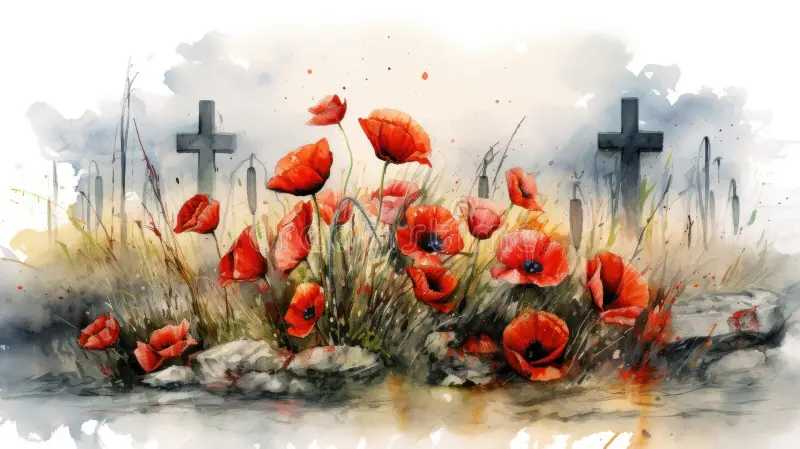
On May 2, 1915, McCrae's close friend and former student, Lieutenant Alexis Helmer, was killed by an artillery shell. With the brigade chaplain unavailable, McCrae conducted the funeral service himself. He observed the simple wooden crosses marking graves in the battlefield and noticed bright red poppies blooming amid the churned-up soil and destruction — a resilient sight in the midst of horror.
The next day, May 3, 1915, McCrae sat in the back of a field ambulance near an advanced dressing station (Essex Farm) and wrote the poem in about 20 minutes. Legend says he initially discarded it, dissatisfied, but fellow soldiers retrieved and admired it.
In Flanders fields the poppies blow
Between the crosses, row on row,
That mark our place; and in the sky
The larks, still bravely singing, fly
Scarce heard amid the guns below.
We are the Dead. Short days ago
We lived, felt dawn, saw sunset glow,
Loved and were loved, and now we lie,
In Flanders fields.
Take up our quarrel with the foe:
To you from failing hands we throw
The torch; be yours to hold it high.
If ye break faith with us who die
We shall not sleep, though poppies grow
In Flanders fields.


Today marks the three hundred and thirtieth birthday of the Frenchman François-Marie Arouet, better known by his nom de plume, Voltaire (1694-1778).
Born into a bourgeois family during the reign of Louis XIV, the “Sun King” (r. 1643-1715), Voltaire suffered tragedy at a young age when his mother died. Never close with his father or brother, Voltaire exhibited a rebellious attitude toward authority from his youth. His brilliant mind was fostered in the care of the Society of Jesus, who introduced him to the joys of literature and theater. Despite his later criticisms against the Church, Voltaire, throughout his life, fondly recalled his dedicated Jesuit teachers.
Although he spent time as a civil servant in the French embassy to the Hague, Voltaire’s main love was writing—an endeavor where he excelled in various genres, including poetry, which led to his appointment as the royal court poet for King Louis XV. Widely recognized as one of the greatest French writers, and even hyperbolically referred to by ...
Padre - Tom Miller invites you to a Coffee Talk, Speakeasies, Schmoozes, Tea Times, Afterhours and other gatherings.
https://teams.live.com/meet/93792382189049?p=DiBHsYfuECPgDrG7vO
2026 Coffee Talk with the ADD Irregulars
Thursday, January 1, 2026
6:00 AM - 8:00 AM (CST)
Occurs every day starting 1/1 until 12/31/2027
Coffee Talk - Daily beginning at 6:00 AM Central Time Zone - USA
Afternoon Chats - Most Tuesday, Friday & Sundays 2:00 PM Central
Always invited, never expected.
Other chats as posted in the community.

Good morning, Digital Neighbors! With all the news out of Europe and the bleakness of the news, it is more important than ever to take a break from it and do something away from the cycle of despair. It will be there when you return, probably worse and with additional confirmation of your assumptions that things are getting worse, that we are approaching a point where return is difficult, if it's even possible. Many in our culture (mostly on the Left) have hated our past, and we are now seeing it consumed in flames in Europe after decades of its slow erasure in academia, media, and entertainment, things I have called the Cabal for the last six years. It is hard when there is an interior erosion and now an explicit exterior attack that you have brought into your own world. I pray that Europe wakes up; I pray we do.
Prayer, reflection, walking, nature, music, a good narrative book or movie: these are the needed medicine for the assault of overconsumption of the news. I don't consider it avoidance; I consider it ...



XIII
The Proud Minister
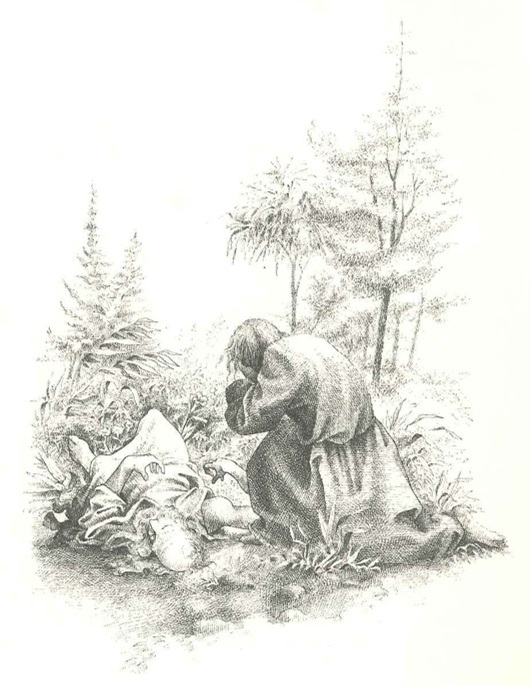
One day there came into the Garden a man in torn clothes badly bruised and cut, who said to the Lover, “In the name of the Beloved I demand your help.”
So the Lover and the Disciple let him in and dressed his wounds and prepared the best of the vegetables from the Garden for him to eat. When his wounds had been dressed and he had eaten and rested the Lover asked him how he had fallen into this plight, to which the man replied, “I was Minister of the Beloved in a city near this place, where I preached His gospel and expounded His doctrine to the people. I pointed out to them how their sins had made them wholly hateful to the Beloved and how therefore they were utterly beyond the range of His love and He would condemn them to eternal torments, whereon some fell into despair and wept bitterly but many were angry. One day the magistrates called me before them and begged me to leave the city and preach elsewhere for they said I had made many people so angry and desperate that they feared there might be a riot and they might not be able to protect me but that I might suffer some injury. I, however, very zealous for the Beloved and believing that the magistrates only feared that their own sins might be proclaimed, preached the more vehemently, denounced the magistrates and made it abundantly clear that the whole wicked city was foredoomed to eternal punishment by the just provision of the Beloved. Whereon a mob, stirred up no doubt by the corrupt and venal magistrates, fell upon me with sticks and stones, nearly killing me and driving me out of the city in the state in which I came to you.”
“My friend,” said the Lover, “this was not a good deed of yours, for besides denying the unfathomable compassion of the Beloved, you have by your obstinacy caused these people to commit a grievous sin, and this cannot be pleasing to the Beloved, that through you who profess to be His minister the people should become worse. Surely you remember that He Himself said, ‘If they persecute you in one city flee to another.’”
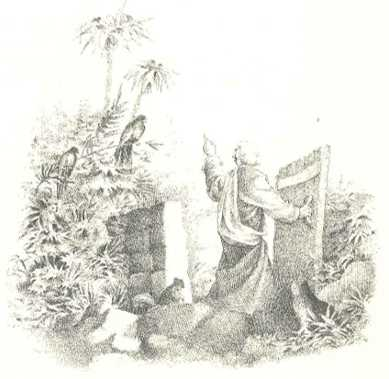
Therefore the man was very angry, and cursing the Lover, said, “I see that I have had a very false report of you and I do not believe that you are a servant of the Beloved at all. When I came to you so injured for the Beloved’s sake you set before me only herbs and fruits although the garden is full of birds which you could have killed to make me a worthy meal. I shall proclaim everywhere that you are no true servant of the Beloved but a mere falterer who dares not suffer in the cause of the Beloved. Be sure that you are foreordained to eternal torments who suffer nothing here.”
For the man was so blinded by his own pride that he could not perceive the scars on the hands and feet and the brows of the Lover nor how the cloth beneath the armpits of his tunic was dyed with a red dye. So he went out of the Garden cursing and shouting.
But the Lover looked sad and said, “A man like this does much harm to the cause of the Beloved, for by thus speaking falsely about the Beloved he may bring men to fear Him but none to love Him, and by love alone can any man approach the Beloved.”