


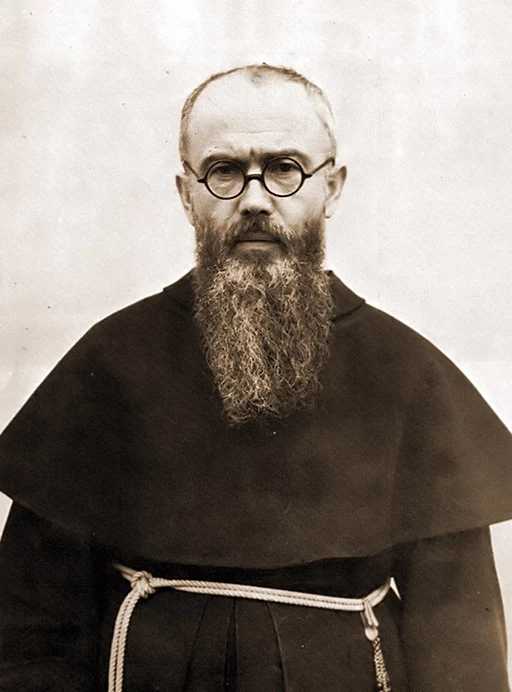
Good morning Digital Neighbors! Happy Wednesday to all. It is the Feast Day of St. Maximillian Kolbe, a few words of wisdom from him in the morning Office. Probably not everyone’s cup of tea, but then again nothing really is. We all vary in what touches the heart, stirs the mind or speaks to our interior self (if you have one). A bit about the saint before we hear his words on apostolic zeal.
Today the Church honors St. Maximilian Kolbe; a Polish Franciscan priest, international publisher of Marian devotion and 20th century martyr. At age 13, he entered a Franciscan minor seminary, becoming ordained at age 24. He held doctorates in theology and philosophy. In 1917, he led a small group of Franciscans to Rome to stand against anti-Catholic demonstrations and formed an association called the Militia Immaculata (M.I.). When he returned to Poland, the M.I. started producing faith periodicals; eventually growing into a publishing house of 650 friars – the largest religious house in the world. With Marian devotion as a focus to Christ, the M.I. began a daily newspaper, a monthly magazine, a radio station, and planned a movie studio. His circulation reached over a million readers and a second location was established in Nagasaki, Japan. In 1941, St. Maximilian was arrested and placed in a Nazi death camp. Shortly after, he died at Auschwitz, from a lethal injection, when he bartered his own life for a man’s who had a family. St. Maximilian is the patron saint of journalists, families, and the chemically addicted.
From the Letters of Maximilian Mary Kolbe
Apostolic zeal for the salvation and sanctification of souls
The burning zeal for God’s glory that motivates you fills my heart with joy. It is sad for us to see in our own time that indifferentism in its many forms is spreading like an epidemic not only among the laity but also among religious. But God is worthy of glory beyond measure, and therefore it is of absolute and supreme importance to seek that glory with all the power of our feeble resources. Since we are mere creatures we can never return to him all that is his due. The most resplendent manifestation of God’s glory is the salvation of souls, whom Christ redeemed by shedding his blood. To work for the salvation and sanctification of as many souls as possible, therefore, is the preeminent purpose of the apostolic life. Let me, then, say a few words that may show the way toward achieving God’s glory and the sanctification of many souls.
God, who is all-knowing and all-wise, knows best what we should do to increase his glory. Through his representatives on earth he continually reveals his will to us; thus it is obedience and obedience alone that is the sure sign to us of the divine will. A superior may, it is true, make a mistake; but it is impossible for us to be mistaken in obeying a superior’s command. The only exception to this rule is the case of a superior commanding something that in even the slightest way would contravene God’s law. Such a superior would not be conveying God’s will.
God alone is infinitely wise, holy, merciful, our Lord, Creator, and Father; he is beginning and end, wisdom and power and love; he is all. Everything other than God has value to the degree that it is referred to him, the maker of all and our own redeemer, the final end of all things. It is he who, declaring his adorable will to us through his representatives on earth, draws us to himself and whose plan is to draw others to himself through us and to join us all to himself in an ever deepening love.
Look, then, at the high dignity that by God’s mercy belongs to our state in life. Obedience raises us beyond the limits of our littleness and puts us in harmony with God’s will. In boundless wisdom and care, his will guides us to act rightly. Holding fast to that will, which no creature can thwart, we are filled with unsurpassable strength.
Obedience is the one and the only way of wisdom and prudence for us to offer glory to God. If there were another, Christ would certainly have shown it to us by word and example. Scripture, however, summed up his entire life at Nazareth in the words: He was subject to them; Scripture set obedience as the theme of the rest of his life, repeatedly declaring that he came into the world to do his Father’s will. Let us love our loving Father with all our hearts. Let our obedience increase that love, above all when it requires us to surrender our own will. Jesus Christ crucified is our sublime guide toward growth in God’s love.
We will learn this lesson more quickly through the Immaculate Virgin, whom God has made the dispenser of his mercy. It is beyond all doubt that Mary’s will represents to us the will of God himself. By dedicating ourselves to her we become in her hands instruments of God’s mercy even as she was such an instrument in God’s hands. We should let ourselves be guided and led by Mary and rest quiet and secure in her hands. She will watch out for us, provide for us, answer our needs of body and spirit; she will dissolve all our difficulties and worries.


Today marks the three hundred and thirtieth birthday of the Frenchman François-Marie Arouet, better known by his nom de plume, Voltaire (1694-1778).
Born into a bourgeois family during the reign of Louis XIV, the “Sun King” (r. 1643-1715), Voltaire suffered tragedy at a young age when his mother died. Never close with his father or brother, Voltaire exhibited a rebellious attitude toward authority from his youth. His brilliant mind was fostered in the care of the Society of Jesus, who introduced him to the joys of literature and theater. Despite his later criticisms against the Church, Voltaire, throughout his life, fondly recalled his dedicated Jesuit teachers.
Although he spent time as a civil servant in the French embassy to the Hague, Voltaire’s main love was writing—an endeavor where he excelled in various genres, including poetry, which led to his appointment as the royal court poet for King Louis XV. Widely recognized as one of the greatest French writers, and even hyperbolically referred to by ...
Padre - Tom Miller invites you to a Coffee Talk, Speakeasies, Schmoozes, Tea Times, Afterhours and other gatherings.
https://teams.live.com/meet/93792382189049?p=DiBHsYfuECPgDrG7vO
2026 Coffee Talk with the ADD Irregulars
Thursday, January 1, 2026
6:00 AM - 8:00 AM (CST)
Occurs every day starting 1/1 until 12/31/2027
Coffee Talk - Daily beginning at 6:00 AM Central Time Zone - USA
White Pilled Wednesday - A break from the heaviness of news and current events to focus upon things more personal & positive for the first hour of Coffee Talk.
Afternoon Chats - Most Tuesday, Friday & Sundays 2:00 PM Central
Other chats as posted in the community.


Good morning, digital neighbors! Blessed Sabbath to all my neighbors in Judaism and happy Saturday to all the rest of us! How about a few quotes on autumn for this fine autumn morning and a trip down memory lane for some of us? Have a great day, my friends!
"Listen! the wind is rising, and the air is wild with leaves, / We have had our summer evenings, now for October eves!" – Humbert Wolfe, "Autumn (Resignation)" (1926)
"Again the wind / flakes gold-leaf from the trees and the painting darkens— / as if a thousand penitents kissed an icon / till it thinned back to bare wood, / without diminishment." – Jane Hirshfield, "Autumn" (The Paris Review, 1988)
"Autumn is the mellower season, and what we lose in flowers we more than gain in fruits." – Samuel Butler, The Way of All Flesh (1903)
When I think of autumn and childhood, I always think of this old Disney cartoon. I probably watch it every autumn in the days leading up to Halloween. Enjoy!
...





XIII
The Proud Minister
One day there came into the Garden a man in torn clothes badly bruised and cut, who said to the Lover, “In the name of the Beloved I demand your help.”
So the Lover and the Disciple let him in and dressed his wounds and prepared the best of the vegetables from the Garden for him to eat. When his wounds had been dressed and he had eaten and rested the Lover asked him how he had fallen into this plight, to which the man replied, “I was Minister of the Beloved in a city near this place, where I preached His gospel and expounded His doctrine to the people. I pointed out to them how their sins had made them wholly hateful to the Beloved and how therefore they were utterly beyond the range of His love and He would condemn them to eternal torments, whereon some fell into despair and wept bitterly but many were angry. One day the magistrates called me before them and begged me to leave the city and preach elsewhere for they said I had made many people so angry and desperate that they feared there might be a riot and they might not be able to protect me but that I might suffer some injury. I, however, very zealous for the Beloved and believing that the magistrates only feared that their own sins might be proclaimed, preached the more vehemently, denounced the magistrates and made it abundantly clear that the whole wicked city was foredoomed to eternal punishment by the just provision of the Beloved. Whereon a mob, stirred up no doubt by the corrupt and venal magistrates, fell upon me with sticks and stones, nearly killing me and driving me out of the city in the state in which I came to you.”
“My friend,” said the Lover, “this was not a good deed of yours, for besides denying the unfathomable compassion of the Beloved, you have by your obstinacy caused these people to commit a grievous sin, and this cannot be pleasing to the Beloved, that through you who profess to be His minister the people should become worse. Surely you remember that He Himself said, ‘If they persecute you in one city flee to another.’”
Therefore the man was very angry, and cursing the Lover, said, “I see that I have had a very false report of you and I do not believe that you are a servant of the Beloved at all. When I came to you so injured for the Beloved’s sake you set before me only herbs and fruits although the garden is full of birds which you could have killed to make me a worthy meal. I shall proclaim everywhere that you are no true servant of the Beloved but a mere falterer who dares not suffer in the cause of the Beloved. Be sure that you are foreordained to eternal torments who suffer nothing here.”
For the man was so blinded by his own pride that he could not perceive the scars on the hands and feet and the brows of the Lover nor how the cloth beneath the armpits of his tunic was dyed with a red dye. So he went out of the Garden cursing and shouting.
But the Lover looked sad and said, “A man like this does much harm to the cause of the Beloved, for by thus speaking falsely about the Beloved he may bring men to fear Him but none to love Him, and by love alone can any man approach the Beloved.”