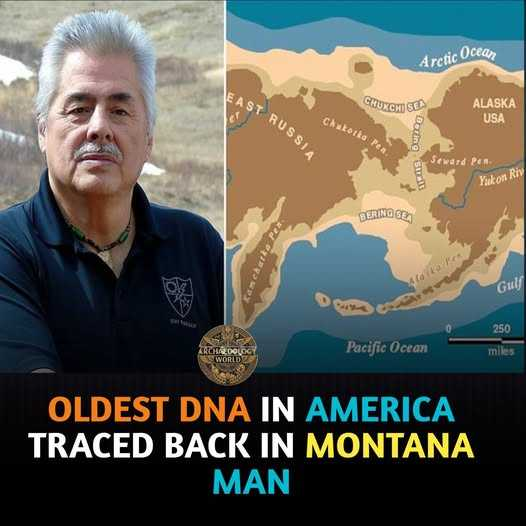
The story involves Darrell "Dusty" Crawford (whose Blackfeet name is Lone Bull), a Blackfeet Native American from Heart Butte, Montana.
When Crawford sent a sample to the commercial genetic testing company CRI Genetics, the results revealed a deep lineage traced back 55 generations (~17,000 years), making it one of the oldest living human DNA lineages documented in North America.
Key Takeaways from the Discovery
Mitochondrial Lineage (Haplogroup B2): Crawford’s maternal lineage belongs to mtDNA Haplogroup B2, a founder lineage in Native American populations that originated around 17,000 years ago in North America. It traces back to a founding maternal ancestor group referred to in genetic studies as the "Ina" clan.
High Genetic Purity: His results showed 83% Native American ancestry, with 73% of that total coming from a single, unbroken ancestral line—a unusually high level of genetic continuity.
Migration Insights: Rather than supporting the traditional Bering Land Bridge route alone, Crawford’s genetic group shows ties to populations that likely traveled down the Pacific coast into South America before dispersing northward.
Scientific Context & Nuance:
While commercial DNA marketing framed this as "finding Bigfoot" in terms of rarity, geneticists note that thousands of Indigenous peoples across the Americas share deep Ice Age-era haplogroups (such as A, B, C, D, and X). Crawford's test simply provided a remarkably clear, unbroken direct line over 17,000 years.
Ancient DNA Context in Montana
It is worth distinguishing living lineage testing from archaeological DNA finds in the same region:
Living Heritage: Darrell Crawford represents the oldest living human lineage continuously traced via consumer genetics in the U.S.
Ancient Skeletal DNA: Montana is also home to the famous Anzick-1 site, where the 12,600-year-old remains of a Clovis-era child yielded the oldest ancient genome ever sequenced in the Americas, proving direct genetic ancestry between Ice Age populations and modern Native Americans.