

Good morning, digital neighbors! Happy Wednesday to all you fine souls scattered across Rubin Report, Phetasy, Outspoken, and Padre’s. Here is a post I shared back on Locals in 2021 in the various communities I was haunting at the time. I share it again on this wonderful morning. Here is a prayer that may be familiar to many of you. It is often associated with Henry Viscardi Jr. and speaks of praying for what we want and receiving what we need. His prayer is most commonly attributed to an unknown Confederate soldier (sometimes called “A Creed for Those Who Have Suffered”). Viscardi used it, popularized it in disability-advocacy circles.
I asked God for strength, that I might achieve. I was made weak, that I might learn humbly to obey.
I asked for health, that I might do greater things. I was given infirmity, that I might do better things.
I asked for riches, that I might be happy. I was given poverty, that I might be wise.
I asked for power, that I might have the praise of others. I was given weakness, that I might feel the need of God.
I asked for all things, that I might enjoy life. I was given life, that I might enjoy all things.
I got nothing that I asked for, but everything I hoped for.
Almost despite myself, my unspoken prayers were answered.
I am most richly blessed.
This is a variation I found on the internet written in the first person. I have often seen it written in the third person (“He asked for…”). Some biographical information about this amazing man that should encourage the rest of us to strive for more rather than whine at the difficulties we will face in life:
Hank Viscardi, the son of an Italian barber, was born in New York City in 1912 with what doctors called “arrested development of the lower limbs.” He spent the first six years of his life in the hospital as doctors tried to strengthen his short, twisted thighs so that they could carry his weight. He underwent many corrective surgeries and endured painful traction. Finally, he was fitted with casts that enabled him to walk. Because of all his hospitalization, Viscardi hardly knew his mother and had not yet met his two sisters.
In the next eight years, Viscardi breezed through the primary grades and high school. He also served as manager of the basketball team and covered school sports for the New York Times. He earned money refereeing basketball games. When his father died, Viscardi and his older sister had to provide for his mother and three younger sisters. Still, when the time came, his family decided that Viscardi would go to college.
Viscardi worked his way through Fordham University by sweeping floors, waiting on tables, and helping in the administration office. He graduated as an honor student.
At age 27, Viscardi was fitted with his first artificial legs. During World War II, he served as a field-service officer for the Red Cross, where he worked with amputees. By 1947, he was director of personnel at Burlington Mills Corp., but he noticed that others with physical disabilities were unable to find employment. This inspired Viscardi to become a pioneer in aiding people with disabilities.
In 1952, Viscardi founded Abilities, Inc., where he helped train adults with disabilities and find them jobs. In 1962, he established the Human Resources School, which was renamed after him in 1992. The author of eight books, he is best known for A Man’s Stature, which was printed in 1952 and reprinted in 1987.
Viscardi advised every president from Franklin D. Roosevelt to Jimmy Carter on issues affecting people with disabilities. He spoke of the philosophy that had sustained him in his pioneering years of work with the disabled when he said, “Life demands love. Loving means to love that which is unlovable, or it is no virtue at all. Faith means believing the unbelievable, and to hope means hoping when things are hopeless.”
Viscardi said that what he achieved personally and professionally could have happened only in America. “In what other land would I, a person born without legs, have been given the opportunity to become a learned man? I learned a great lesson from the doctor who gave me artificial legs,” he said. “When I couldn’t pay his bill, he told me if I would make the difference for one other life, a life dependent on the charity of family or the community, that his bill would be repaid. I’m still paying that bill.”
1983 Horatio Alger Award Recipient. (The above information was taken from their site.)
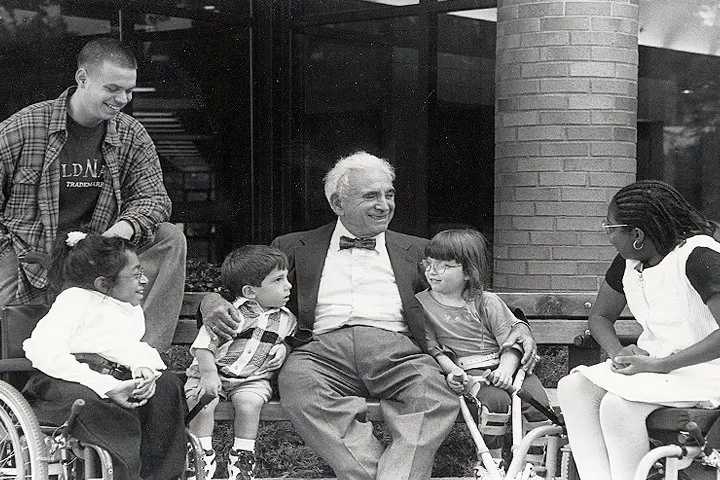
Hank Viscardi with children


Today marks the three hundred and thirtieth birthday of the Frenchman François-Marie Arouet, better known by his nom de plume, Voltaire (1694-1778).
Born into a bourgeois family during the reign of Louis XIV, the “Sun King” (r. 1643-1715), Voltaire suffered tragedy at a young age when his mother died. Never close with his father or brother, Voltaire exhibited a rebellious attitude toward authority from his youth. His brilliant mind was fostered in the care of the Society of Jesus, who introduced him to the joys of literature and theater. Despite his later criticisms against the Church, Voltaire, throughout his life, fondly recalled his dedicated Jesuit teachers.
Although he spent time as a civil servant in the French embassy to the Hague, Voltaire’s main love was writing—an endeavor where he excelled in various genres, including poetry, which led to his appointment as the royal court poet for King Louis XV. Widely recognized as one of the greatest French writers, and even hyperbolically referred to by ...
Padre - Tom Miller invites you to a Coffee Talk, Speakeasies, Schmoozes, Tea Times, Afterhours and other gatherings.
https://teams.live.com/meet/93792382189049?p=DiBHsYfuECPgDrG7vO
2026 Coffee Talk with the ADD Irregulars
Thursday, January 1, 2026
6:00 AM - 8:00 AM (CST)
Occurs every day starting 1/1 until 12/31/2027
Coffee Talk - Daily beginning at 6:00 AM Central Time Zone - USA
Afternoon Chats - Most Tuesday, Friday & Sundays 2:00 PM Central
Always invited, never expected.
Other chats as posted in the community.

I will go back to something I've been saying for a while
Ukraine was a diversion while Europe was silently invaded
Putin/Russia may not be "the good guys" but they did warn Europe and the US
It has pissed a lot of people off in the past pointing this out
But the brutal truth (as if there is any other kind) is in your face now
Deal with the real threat as harshly as necessary
Or be swept into the ash-bin of history



XIII
The Proud Minister
One day there came into the Garden a man in torn clothes badly bruised and cut, who said to the Lover, “In the name of the Beloved I demand your help.”
So the Lover and the Disciple let him in and dressed his wounds and prepared the best of the vegetables from the Garden for him to eat. When his wounds had been dressed and he had eaten and rested the Lover asked him how he had fallen into this plight, to which the man replied, “I was Minister of the Beloved in a city near this place, where I preached His gospel and expounded His doctrine to the people. I pointed out to them how their sins had made them wholly hateful to the Beloved and how therefore they were utterly beyond the range of His love and He would condemn them to eternal torments, whereon some fell into despair and wept bitterly but many were angry. One day the magistrates called me before them and begged me to leave the city and preach elsewhere for they said I had made many people so angry and desperate that they feared there might be a riot and they might not be able to protect me but that I might suffer some injury. I, however, very zealous for the Beloved and believing that the magistrates only feared that their own sins might be proclaimed, preached the more vehemently, denounced the magistrates and made it abundantly clear that the whole wicked city was foredoomed to eternal punishment by the just provision of the Beloved. Whereon a mob, stirred up no doubt by the corrupt and venal magistrates, fell upon me with sticks and stones, nearly killing me and driving me out of the city in the state in which I came to you.”
“My friend,” said the Lover, “this was not a good deed of yours, for besides denying the unfathomable compassion of the Beloved, you have by your obstinacy caused these people to commit a grievous sin, and this cannot be pleasing to the Beloved, that through you who profess to be His minister the people should become worse. Surely you remember that He Himself said, ‘If they persecute you in one city flee to another.’”
Therefore the man was very angry, and cursing the Lover, said, “I see that I have had a very false report of you and I do not believe that you are a servant of the Beloved at all. When I came to you so injured for the Beloved’s sake you set before me only herbs and fruits although the garden is full of birds which you could have killed to make me a worthy meal. I shall proclaim everywhere that you are no true servant of the Beloved but a mere falterer who dares not suffer in the cause of the Beloved. Be sure that you are foreordained to eternal torments who suffer nothing here.”
For the man was so blinded by his own pride that he could not perceive the scars on the hands and feet and the brows of the Lover nor how the cloth beneath the armpits of his tunic was dyed with a red dye. So he went out of the Garden cursing and shouting.
But the Lover looked sad and said, “A man like this does much harm to the cause of the Beloved, for by thus speaking falsely about the Beloved he may bring men to fear Him but none to love Him, and by love alone can any man approach the Beloved.”