

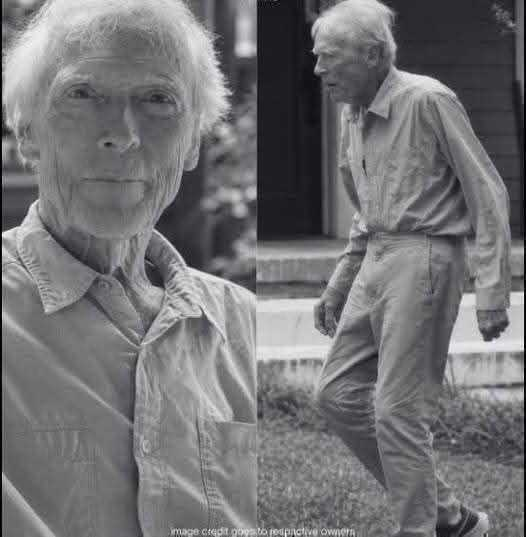
"At 96, Clint Eastwood shattered our comfortable illusions about growing old, refusing to sugarcoat the harsh truth.
In a recent speech, he explained how the body changes over time. Bones become less flexible, movements slow down, and bright light can bother the eyes. Even breathing can take more effort. And that was just the beginning.
He brought his trademark grit to a topic most people prefer to avoid. He didn't offer comforting platitudes about senior years being full of endless serenity.
Instead, he painted a stark, unflinching picture of what happens when a human being approaches a century of existence.
""The light hurts your eyes, and even breathing can feel like hard work,"" Eastwood shared, describing the constant friction of a fading physical frame.
""Your body just doesn't cooperate the way it used to, and every step requires a strategy.""
But as he pointed out, the structural decline of the skeleton and muscles is merely the surface of the issue.
The real weight of extreme old age is emotional and psychological. Once you cross into your nineties, your social landscape undergoes a profound and often painful transformation.
You look around and realize that the majority of the people who knew you when you were young, who shared your history, your inside jokes, and your life struggles, have vanished.
The circle of familiar faces shrinks down to almost nothing, the phone stops ringing, and the pace of the days slows down to a crawl. The bitterest pill to swallow isn't the physical pain; it is the sudden absence of someone who genuinely wants to listen to you.
When the present moment becomes quiet and isolated, the human mind naturally seeks refuge in the past. Eastwood explained that navigating through old memories isn't a sign of mental weakness, but a vital search for continuity.
This is why older people frequently repeat the same anecdotes, adding minor details and revisiting old grounds over and over again. They aren't trying to boast or dominate the conversation. They do it to anchor themselves to a reality where they were active, loved, and relevant.
""You find yourself repeating stories, adding details, not to convince anyone, but just to feel like you’re still connected to something,"" Eastwood admitted. ""You try to pass things down to the younger generation, even when you can see the boredom in their eyes.""
We live in a culture that treats longevity like a trophy, congratulating people simply for surviving, while totally ignoring the crushing loneliness that accompanies that survival.
We praise the shiny, the fast, and the hyper-connected, leaving absolutely no space for the slow, repetitive rhythm of the very old.
Clint Eastwood may be a cinematic giant, but his words speak for every anonymous 90-year-old living down the street or sitting at our family dinner tables.
They are the living libraries of our history, carrying stories that shaped the world we walk in today. When we choose to slow down, put away our distractions, and truly listen to them, something magical happens. We bridge the gap between generations.
Ultimately, the wrinkles on their faces aren't just signs of aging—they are a beautiful roadmap of a life fully lived, and it is a privilege to sit by their side and listen to the journey"
At 96, Clint Eastwood shared a truth about aging that left the world silent… because the hardest part of growing old isn’t losing strength — it’s realizing how many people and memories you’ve lost along the way.


Today marks the three hundred and thirtieth birthday of the Frenchman François-Marie Arouet, better known by his nom de plume, Voltaire (1694-1778).
Born into a bourgeois family during the reign of Louis XIV, the “Sun King” (r. 1643-1715), Voltaire suffered tragedy at a young age when his mother died. Never close with his father or brother, Voltaire exhibited a rebellious attitude toward authority from his youth. His brilliant mind was fostered in the care of the Society of Jesus, who introduced him to the joys of literature and theater. Despite his later criticisms against the Church, Voltaire, throughout his life, fondly recalled his dedicated Jesuit teachers.
Although he spent time as a civil servant in the French embassy to the Hague, Voltaire’s main love was writing—an endeavor where he excelled in various genres, including poetry, which led to his appointment as the royal court poet for King Louis XV. Widely recognized as one of the greatest French writers, and even hyperbolically referred to by ...
Padre - Tom Miller invites you to a Coffee Talk, Speakeasies, Schmoozes, Tea Times, Afterhours and other gatherings.
https://teams.live.com/meet/93792382189049?p=DiBHsYfuECPgDrG7vO
2026 Coffee Talk with the ADD Irregulars
Thursday, January 1, 2026
6:00 AM - 8:00 AM (CST)
Occurs every day starting 1/1 until 12/31/2027
Coffee Talk - Daily beginning at 6:00 AM Central Time Zone - USA
White Pilled Wednesday - A break from the heaviness of news and current events to focus upon things more personal & positive for the first hour of Coffee Talk.
Afternoon Chats - Most Tuesday, Friday & Sundays 2:00 PM Central
Other chats as posted in the community.








XIII
The Proud Minister
One day there came into the Garden a man in torn clothes badly bruised and cut, who said to the Lover, “In the name of the Beloved I demand your help.”
So the Lover and the Disciple let him in and dressed his wounds and prepared the best of the vegetables from the Garden for him to eat. When his wounds had been dressed and he had eaten and rested the Lover asked him how he had fallen into this plight, to which the man replied, “I was Minister of the Beloved in a city near this place, where I preached His gospel and expounded His doctrine to the people. I pointed out to them how their sins had made them wholly hateful to the Beloved and how therefore they were utterly beyond the range of His love and He would condemn them to eternal torments, whereon some fell into despair and wept bitterly but many were angry. One day the magistrates called me before them and begged me to leave the city and preach elsewhere for they said I had made many people so angry and desperate that they feared there might be a riot and they might not be able to protect me but that I might suffer some injury. I, however, very zealous for the Beloved and believing that the magistrates only feared that their own sins might be proclaimed, preached the more vehemently, denounced the magistrates and made it abundantly clear that the whole wicked city was foredoomed to eternal punishment by the just provision of the Beloved. Whereon a mob, stirred up no doubt by the corrupt and venal magistrates, fell upon me with sticks and stones, nearly killing me and driving me out of the city in the state in which I came to you.”
“My friend,” said the Lover, “this was not a good deed of yours, for besides denying the unfathomable compassion of the Beloved, you have by your obstinacy caused these people to commit a grievous sin, and this cannot be pleasing to the Beloved, that through you who profess to be His minister the people should become worse. Surely you remember that He Himself said, ‘If they persecute you in one city flee to another.’”
Therefore the man was very angry, and cursing the Lover, said, “I see that I have had a very false report of you and I do not believe that you are a servant of the Beloved at all. When I came to you so injured for the Beloved’s sake you set before me only herbs and fruits although the garden is full of birds which you could have killed to make me a worthy meal. I shall proclaim everywhere that you are no true servant of the Beloved but a mere falterer who dares not suffer in the cause of the Beloved. Be sure that you are foreordained to eternal torments who suffer nothing here.”
For the man was so blinded by his own pride that he could not perceive the scars on the hands and feet and the brows of the Lover nor how the cloth beneath the armpits of his tunic was dyed with a red dye. So he went out of the Garden cursing and shouting.
But the Lover looked sad and said, “A man like this does much harm to the cause of the Beloved, for by thus speaking falsely about the Beloved he may bring men to fear Him but none to love Him, and by love alone can any man approach the Beloved.”