





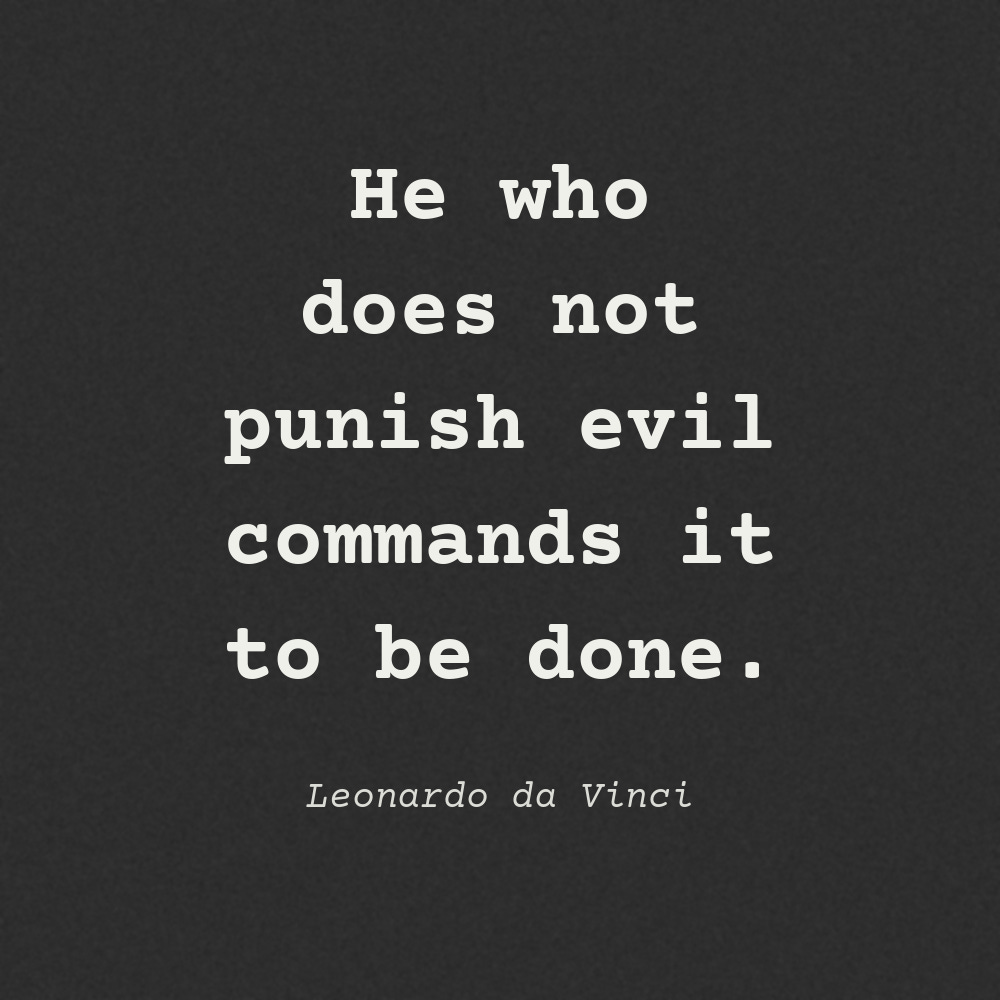
Good afternoon, kind readers! Well, I don’t know when you will read this, but this is when it’s penned. My reflection is in response to a post over on Padre’s Locals page, where one of the members posted a quote from Leonardo da Vinci. They posted it as “Not to punish evil is equivalent to authorizing it.” A closer translation is sharper:
“He who does not punish evil commands it to be done.” – Leonardo da Vinci
I thought it an interesting quote and did some background checking on it because it prompted me to want to write about mercy, forgiveness, and justice. Too many Christians and far too many modern people think that once you forgive someone, everything is magically better. “I am sorry.” “You’re sorry.” “We are all sorry.” Or, as the King says at the Swamp Castle wedding in Monty Python and the Holy Grail, “This is supposed to be a happy occasion. Let’s not bicker and argue about who killed who.”
Contrition is not a magical, make-it-all-better experience; it is the beginning of taking accountability, the beginning of making amends where possible. Many people miss both of those aspects of the dynamics of contrition, mercy, and reconciliation. The whole angle of justice is left out when amends are not made. When and where possible, amends are always the step following accountability.
St. John Paul II wrote about this in his encyclical Dives in Misericordia (no. 14). Evil does not get a pass just because it can be forgiven. Justice requires that the doer of evil be held accountable for his or her trespasses. There is often a requirement of reparation, compensation, and satisfaction to be made when possible. Society has an obligation to protect itself from evil. When it fails to do so, society fails at justice. In the West we are facing a crisis in justice. Some of it is out of misapplied mercy, but much more of it is from hatred of our history and our own identity.
The enemies of civilization and order want chaos and instability. They want fear and terror so that they can propose a new order. Can you guess who will be in charge? Many on the Left side of politics hate our Western heritage and think nothing of doing all they can to undermine it. I am not saying the Right is perfect by any stretch, but the Left controls almost all cultural institutions, such as the media, education (lower and higher), entertainment, and much of technology. The Left dominates the political careerists in D.C. Sorry for that side trip into politics; this is mainly about faith and culture, but politics is affected by the prospering or decay of faith and culture. Since WWII, faith has been in decline in the West, and culture has been eroding away for the last 60 or so years.
The Church in her pilgrimage through time has always held to a belief in temporal punishment due to sin. When we have done our neighbor a wrong, there is restitution to be made. While mercy can forgive the eternal punishment, one still has to face consequences, in this life or the next, for the evil one did. The consequences of sin and evil are not all magically erased by words of contrition. The words open the door to grace and forgiveness, but the work of reconciliation takes time, effort, and atonement.
All Christians and Jews believe they are headed to a place of judgment before God. Jews believe they will be judged by the goodness of their lives and how that corresponds with the law of God. Christians will be judged as well by their deeds and how they showed the fruit of Christian discipleship, or its lack. All Christians believe they are saved by Christ; there is no salvation apart from Him. Catholics and other Christians believe that our actions, cooperating with grace, sanctify us and help us “put on Christ” as His mature disciples. Jesus does the heavy lifting without which nothing could save us, but by the power of His grace we can grow in goodness and holiness and so make a small return to God in how we served Him and loved both God and neighbor.
Civil justice is a different matter, but it rests on the same principle of accountability. Some evils cannot be remedied easily in this life, which is why the Church for centuries allowed the death penalty: the offender had forfeited the right to live among us. In 2018 the Catechism was revised to call the death penalty “inadmissible” (CCC 2267), but the Church still holds that society has a right (and obligation) to protect itself from evil, both within and without. Individuals have the right and freedom to protect themselves, their loved ones, and their property. The military protects us from evils outside of society, and law enforcement and the legal system are supposed to protect us from the evil within society. I tend to sit on the fence about the death penalty. When the evil is inescapable and beyond doubt, I don’t know that a society has an obligation to provide for the criminally evil.
Of course, one of the dangers of the death penalty in the past was the execution of the innocent. People have been arrested, incarcerated, and executed based on hateful bias and the corrupt judgment of the legal system. All human beings have biases, some grounded, others based on bigotry and baseless assumptions. Not all biases are bad; those grounded in reality and informed by faith have the potential to foster virtue and a better society. Virtue takes awareness and consistent effort to grow; vice does not. Left to our own devices, we can slide into vice very easily. If you think wrong, chances are you will act wrong, and when too many of us act wrongly, all of us will suffer. You would think that is so basic it ought to be self-evident, but it is not, because of fundamental disagreements about what is vice and what is virtue. The Left and Islam do not support Judeo-Christian values based on the Ten Commandments and the Bible.
Christianity and Judaism don’t sugarcoat the reality of human sinfulness and its subsequent evil. We may have been created good at the beginning, but we are born with a broken nature that is inclined to sin. In the absence of God, humanity became wholly corrupt from the time of Cain until only Noah and his family were left as righteous. Left to its own devices, humanity slides into all kinds of evil and depravity. Ancient history is full of countless atrocities and brutalities of one nation against another. It takes generations to climb out of and away from that animalistic brutality that lies in our broken nature, and it takes no time to revert to it when we become unmoored from our foundation of faith.
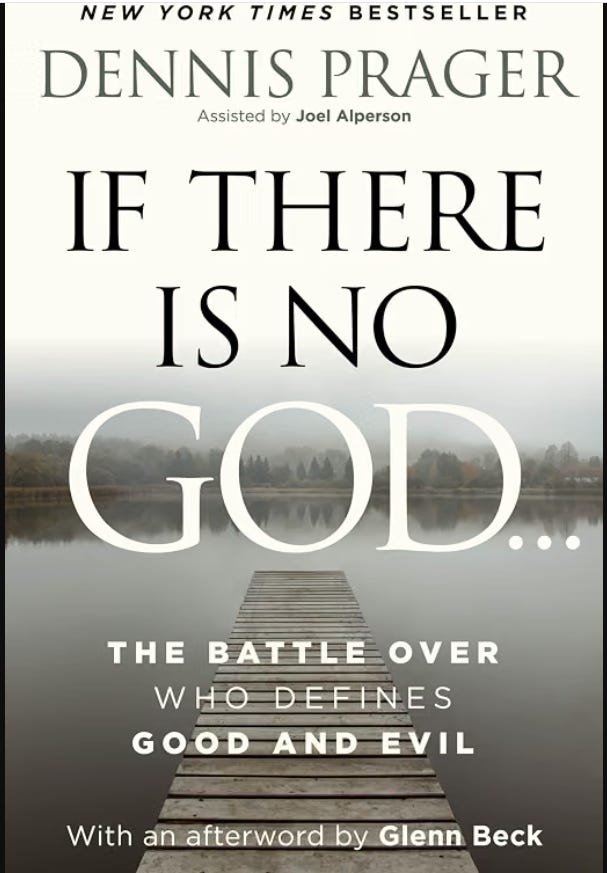
A good place to further your thoughts on this subject is If There Is No God: The Battle Over Who Defines Good and Evil, taken from a 1992 weekend of Dennis Prager talking with young people at a conference. The book’s dialogue format is a bit clunky, but once you get used to it, Dennis has his usual persuasive arguments and kindly refutations of those not thinking through the consequences of their statements. While I sit on the fence about the death penalty, I completely understand his argument for it and mostly subscribe to it. I walk with the Church, not apart from it. But asking questions and wrestling with doubts are all part of growth in moral and spiritual maturity. My only caveat is that you cannot give an innocent man his life back; how do you rectify that injustice? Of course, many innocent lives are taken by murder every day, and little is done about it beyond excusing accountability and coddling the murderer. Either our culture gets massive reform, or we will suffer more societal decay that slides us closer and closer to barbarism and brutality.
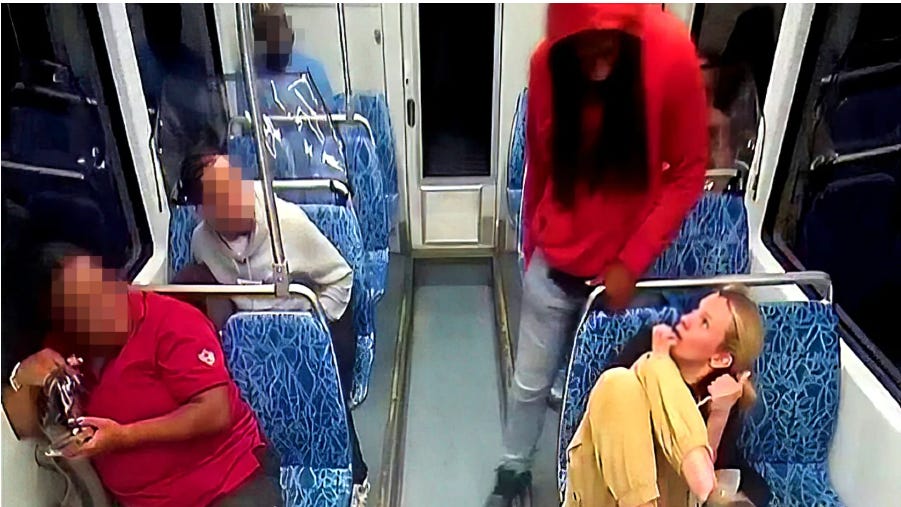
Remember Iryna Zarutska.
As a final note, Dennis is not arguing from a proof of God or making some philosophical claim that God exists. He states that if God does not exist, specifically the God of Sinai and the One whom Christians believe Jesus called Father, morality boils down to opinion and feelings. Here are four points taken from his book that are essential to grounding in reality and not floating about in feelings:
Values must override feelings. His test case asks whether you’d save your drowning dog or a drowning stranger. You may love the dog more, but a human being made in God’s image comes first.
Doing good matters more than feeling good. A man who gives $50 out of duty does more than a man who weeps and gives $1.
People aren’t basically good. Goodness has to be taught and practiced, and the Holocaust shows how readily ordinary people do evil.
Society can't be the source of values. If it were, the Nazis' values would have been "good" in Nazi Germany.
If you are inclined to wade into this subject more, check out this video as an introduction and then read the book.
Mercy does not free us from the pursuit of justice. While mercy can free us of the guilt of our wrongdoing and the ultimate consequences from God, it does not free us from accountability in this life and the need to make restitution where possible.
God’s desire to free us from our guilt comes with His desire to have us become better sons and daughters. God wants our conversion, not compulsion. There is a religion all about submission in its very name. It is not Judeo-Christian. Sorry. that is a sidebar. No one is a bigger advocate of free will than God, but free will is not to be exercised with the emotional guidance of a four-year-old. We are called to integrate emotions and thoughts into a decision or decisions that are subject to a will that seeks the enlightenment of God and His commands.
Bonus Video